
What does tuber mean?
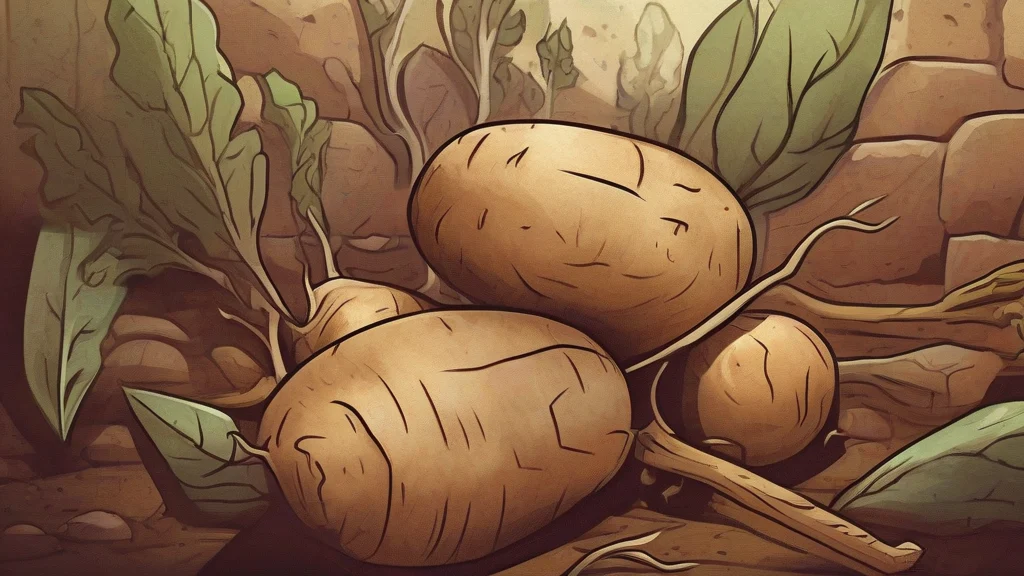
A tuber is a swollen, usually underground plant structure that stores nutrients and can grow into a new plant. In everyday botany, the term most often describes a modified stem, as in potatoes, while related underground organs include bulbs and corms. The word also has a general anatomical sense for a rounded projection or swelling, and historically it can refer to any lump or protuberance. In current English, tuber is most familiar as a noun in agriculture and horticulture, where it names the storage organ of crops such as potatoes, yams, and Jerusalem artichokes. Its distinctions are technical: a tuber is chiefly stem tissue, whereas a bulb is organized around a bud and leaves. The word is neutral and common in botanical, agricultural, and anatomical contexts. It remains useful because it names a category of plant structure rather than merely a root, a common point of confusion; even the familiar potato is botanically a tuber rather than a true root.
nounA swollen, usually underground plant organ, chiefly a modified stem, that stores food and can grow into a new plant. By extension, a rounded swelling or projection, especially in anatomy.
- Botany: an enlarged, usually underground storage organ formed mainly from stem tissue.
- Anatomy: a rounded projection or swelling on a body or organ.
- General or historical: any knob, lump, or protuberance.
"The farmer planted each potato tuber deep enough to keep it covered by soil."
"Each tuber in the seed bed was carefully lifted and stored for the following season."
"The anatomical description identifies a small tuber near the base of the skull."
The regular plural is used for both botanical storage organs and anatomical projections.
"Each tuber can be planted to produce a new crop."
The potato everyone calls a root is actually a tuber—a swollen underground stem built to store food.
Reviewed by Deb Chak, Editor. AI-assisted content curated by RJS Tech Solutions LLP.
Where does tuber come from?
English tuber entered Middle English from Old French tubere, ultimately from Latin tuber, meaning a swelling or protuberance. The deeper origin of the Latin word is uncertain. Its botanical use developed from the general sense of a rounded swelling, while related forms such as tubercle and tuberculate retain the same Latin root.
Related word forms
How tuber is actually used
The word is neutral in register. Its botanical and anatomical senses are technical, while the general sense for an arbitrary lump or projection is now uncommon.
Easily confused with tuber
Both are underground plant structures, but a bulb is organized around a bud and fleshy leaf bases, whereas a tuber is chiefly enlarged stem tissue.
A tuber can be a normal rounded projection, whereas a tumor is an abnormal mass of tissue.