
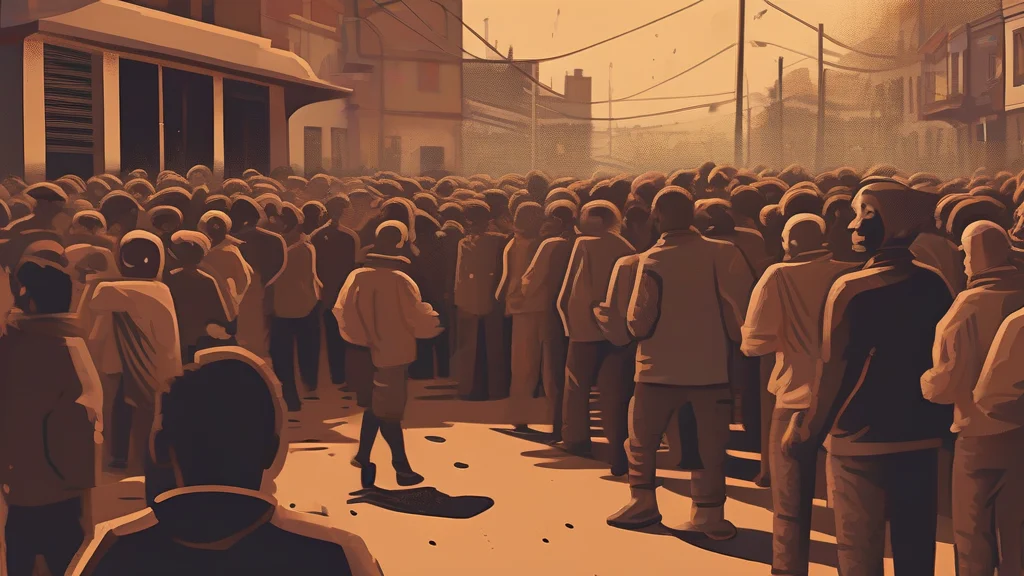
What does tumult mean?
Tumult denotes a loud and confused commotion, especially the noise and disorder produced by an excited crowd. It also describes social or political upheaval, as in a period of political tumult, and can figuratively refer to emotional agitation or confusion. The word often carries a dramatic or elevated tone, suggesting an event in which ordinary order has been disrupted. Its historical associations strengthen that impression: the English word comes from a Latin term connected with swelling or rising, evoking both the surge of a crowd and the intensification of its noise. In modern usage, tumult is less common in everyday speech than words such as commotion, uproar, or turmoil, but it remains effective in formal prose, journalism, and literary description when the scale or disorder of an event merits emphasis.
A loud, confused noise or commotion, especially one caused by an excited crowd or a disturbance in social or political life.
"A tumult spread through the hall as people began to shout."
Often used for dramatic, public, or historical disturbances; it may also refer figuratively to emotional agitation.
To be in a state of violent commotion or agitation.
"The audience tumulted noisily before the speaker could continue."
Rare and chiefly literary or historical.
Usually singular; the plural is used when referring to separate instances of commotion or disturbance.
"The archive records several tumults in the city during the 1840s."
The word began with an image of swelling: its Latin ancestor evokes a rising surge of noise and disorder.
Reviewed by Deb Chak, Editor. AI-assisted content curated by RJS Tech Solutions LLP.
Where does tumult come from?
The English word derives from Latin tumultus, meaning “commotion” or “uproar,” which is related to Latin tumescere, “to swell” or “to rise.” Its history therefore carries an image of forces gathering and swelling into a noisy disturbance. The derivative tumultuous preserves this association with disorder, agitation, and vigorous movement.
Related word forms
How tumult is actually used
Tumult is somewhat formal and literary. It can sound more dramatic than ordinary words such as “noise” or “commotion,” particularly when describing public or historical events.
Easily confused with tumult
Tumult often emphasizes the noise and confusion of a disturbance, whereas turmoil more commonly refers to political, social, or emotional upheaval.