
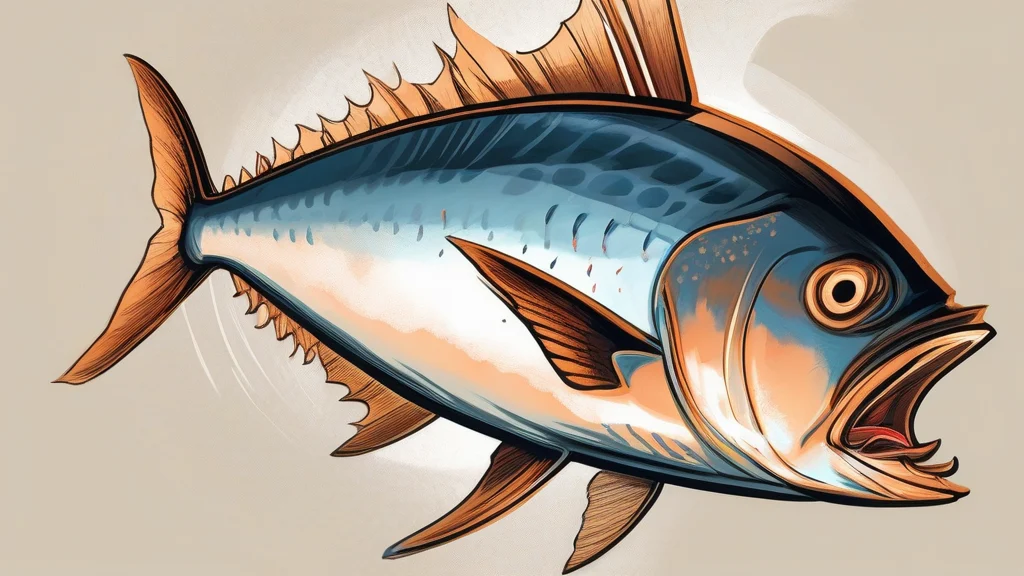
What does tuna mean?
A tuna is a large, fast-swimming marine fish belonging to a group of species that includes several commercially important food fish. Tuna are noted for their streamlined bodies, powerful swimming, and extensive migrations, with some populations travelling thousands of miles across open ocean. In everyday English, "tuna" can denote either the living fish or its flesh as food, so the phrase "a can of tuna" usually refers to preserved pieces of fish rather than a whole animal. The word commonly appears in expressions such as "canned tuna," "tuna sandwich," and "tuna salad." It is also important in discussions of sustainable fishing because different tuna species are subject to varying levels of conservation and fishing pressure. Although the animal is sometimes confused linguistically with a tune, a melody, the two meanings belong to entirely separate vocabulary histories.
nounA large, fast-swimming marine fish, especially a species of the genus Thunnus, many of which migrate long distances and are valued as food. The word can also refer to the flesh of these fish when eaten.
- Any of various large, fast-swimming marine fishes of the tuna group, many of which are migratory and valued as food.
- The flesh of a tuna, used as food.
"She served the guests a salad with fresh tuna, cucumber, and a lemon dressing."
"We grilled tuna steaks with lemon, garlic, and fresh herbs."
"The pantry contained several cans of tuna, pasta, and tomato sauce."
The plural is normally "tuna"; "tunas" is also accepted.
"The fishermen unloaded several tuna onto the dock."
Some tuna undertake ocean-spanning migrations, travelling thousands of miles between feeding grounds and breeding areas.
Reviewed by Deb Chak, Editor. AI-assisted content curated by RJS Tech Solutions LLP.
Where does tuna come from?
The English word entered use in the early 16th century through Spanish, whose tuna derives from Latin thunnus. Latin thunnus in turn comes from Greek thynnos, the ancient Greek name for tuna-like fish. Older English forms such as tunny and thon reflect the same Latin and French transmission, while modern tunas and tunnies continue the established English noun.
How tuna is actually used
The word is neutral in register and is common in culinary as well as biological contexts. In British and American English, the plural is normally "tuna," although "tunas" is also used.
Easily confused with tuna
A tuna is a large marine fish, whereas a tune is a melody or song.