
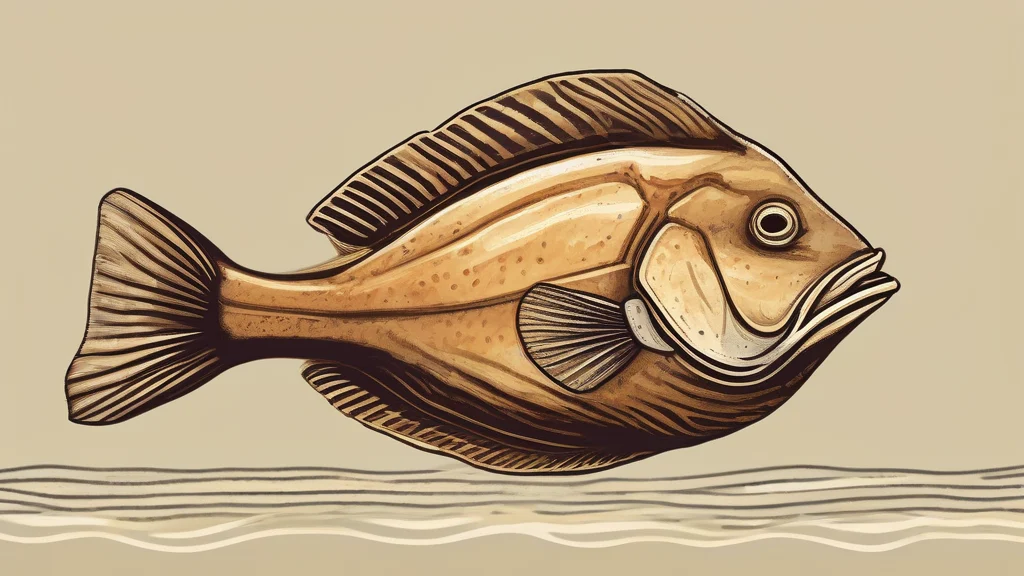
What does turbot mean?
Turbot is the common name of a large, valuable flatfish native to the northeastern Atlantic and Mediterranean. Its body is broad and nearly circular, and both eyes lie on its upper surface, adaptations typical of fish that live and hunt on the seabed. Turbot is especially valued for its delicate, firm white flesh, which can be grilled, roasted, steamed, or pan-seared. In restaurants and fish markets, the term may refer either to the whole fish or to a cut from it, particularly a fillet or steak. Although turbot belongs to the same broad group as sole, plaice, and halibut, it is a distinct species and is not used as a collective label for all flatfish. The word is firmly established in British and American English, with minor pronunciation differences between the two varieties. Its historical name is associated with the Latin word for a spinning top, probably because of the fish's rounded outline.
nounA large edible flatfish, Scophthalmus maximus, found in the northeastern Atlantic and Mediterranean. It is valued for its delicate white flesh and is commonly prepared whole or as a fillet.
- The large European flatfish Scophthalmus maximus, prized as a food fish for its firm, delicate white flesh.
"For dinner, she pan-seared a turbot fillet with lemon and fresh herbs."
"The fishmonger recommended a whole turbot for roasting."
"Turbot is often served with lemon, butter, and seasonal vegetables in fine-dining restaurants."
The ordinary plural is turbots. In culinary and seafood contexts, the singular form is also used unchanged when counting fish, especially on menus.
"They ordered two turbot for dinner."
Turbot's name is linked to a spinning top—a fitting image for a flat fish that glides across the seabed.
Reviewed by Deb Chak, Editor. AI-assisted content curated by RJS Tech Solutions LLP.
Where does turbot come from?
English borrowed the word from Old French tourbot, which was derived from a medieval Latin form. That name is generally traced to Latin turbo, meaning a spinning top, in reference to the fish's rounded shape. The modern word turbo was borrowed much later through French and Italian from the same Latin noun but developed entirely unrelated mechanical meanings.
How turbot is actually used
The word is used in culinary, restaurant, and seafood-market contexts as well as in general reference. It is not a general synonym for flatfish: other flatfish, including plaice and sole, retain their own names.
Easily confused with turbot
A turbot is a flatfish, whereas a turbo is a turbine or the term for forced induction that increases an engine's power.