
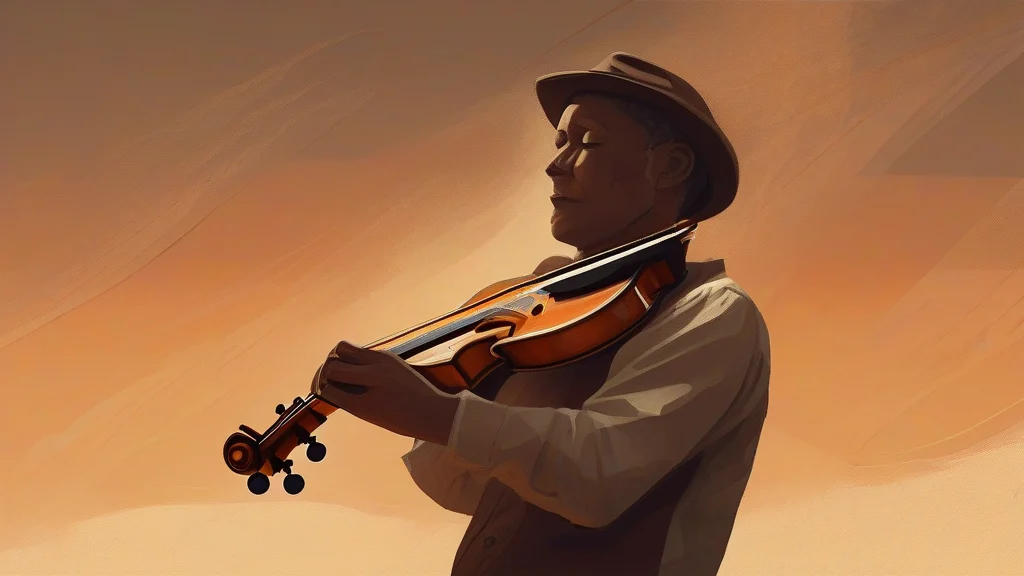
What does twanging mean?
Twanging is the present participle of twang and describes the act or sound of plucking a string or causing a string to vibrate. It is especially associated with guitars, fiddles, banjos, harps, and other stringed instruments. The characteristic twanging sound is sharp, bright, and resonant, so the word often appears in descriptions of music heard in a rural, folk, or informal setting, though it is not limited to those contexts. As an adjective, twanging modifies a string or its sound; as a noun, it can denote either the action or the resulting sound. The related noun twang also refers to a pronounced regional or vocal accent, but that meaning is not normally extended to twanging. Twanging is consequently a vivid and precise term for an action and sound that are otherwise difficult to describe without suggesting a broader musical texture.
To pluck or cause a string to vibrate so that it produces a sharp, resonant sound.
"He kept twanging the strings of his battered banjo."
This is the present participle of twang and is commonly used in descriptions of music or the handling of a stringed instrument.
Characterized by a sharp, ringing sound produced by a plucked or vibrating string.
"The twanging strings carried through the open doorway."
Usually used attributively before a noun, especially strings, instruments, or music.
The action of plucking a string or the sharp, resonant sound produced by it.
"A sudden twanging interrupted the conversation."
The noun is usually used as a mass noun; the plural twangings is uncommon.
The plural is rare; twanging is normally used as a mass noun for the action or sound.
"The occasional twangings from the next room were unmistakable."
Twanging captures a plucked string in one word: sharp, bright, and unmistakably musical.
Reviewed by Deb Chak, Editor. AI-assisted content curated by RJS Tech Solutions LLP.
Etymology of twanging
Twanging is an English formation based on twang, the base word for a sharp, resonant sound and for the action of plucking a string. Twang is generally understood as an imitative formation modeled on the sound it names. The same root also produced related forms such as twangle, twangler, and twangy, although their deeper historical origin is less certain than their relationship to twang.
Related word forms
How twanging is actually used
The word is neutral in register but often evocative or literary. It most commonly describes the sound or action associated with guitars, fiddles, banjos, and similar instruments. For a vocal or regional accent, the usual noun is twang rather than twanging.