
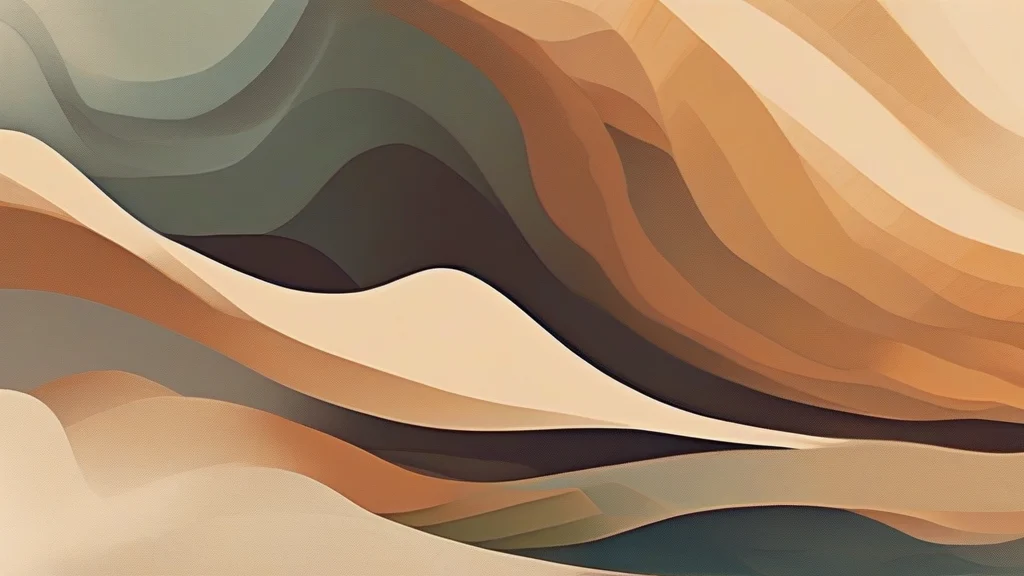
What does undulation mean?
Undulation denotes a wave-like movement, shape, or pattern. It commonly describes the gentle rising and falling of a road, landscape, surface, fabric, or human body, as in “the undulation of the hills.” The word can also refer to repeated changes in level or appearance, especially when they form a smooth, flowing series. Its tone is formal and often literary, but it remains precise in geographical, physical, and scientific contexts. Unlike “irregularity,” which suggests a lack of pattern, undulation emphasizes movement or form resembling waves. It is also broader than “ripple,” which often implies a smaller or more localized wave. Understanding undulation is useful because it captures the characteristic quality of something that rolls, rises, falls, or curves rhythmically, whether in physical landscapes, measured quantities, or figurative descriptions of movement and style.
nounA wave-like movement or form, especially a gentle succession of rises and falls in a surface, line, or body.
- A wave-like or rolling movement, especially a gentle rising and falling.
- A wavy line, outline, or surface.
- A series of rises and falls in movement, level, or appearance.
"The road followed every gentle undulation of the surrounding hills."
"A faint undulation in the surface of the lake revealed the breeze."
"The singer's voice was marked by a graceful undulation that held the audience's attention."
The plural is used for several waves or for repeated rises and falls in a surface, landscape, or line.
"Small undulations in the grassland stretched toward the horizon."
Undulation carries a wave in its DNA: it describes everything from rolling terrain to the rippling motion of fabric.
Reviewed by Deb Chak, Editor. AI-assisted content curated by RJS Tech Solutions LLP.
Where does undulation come from?
Undulation comes from Latin undulatio, a noun meaning “a waving,” formed from undulare, “to wave.” The Latin verb derives from unda, meaning “wave.” The English noun was borrowed in the early 17th century and became especially associated with wave-like movement and form.
Related word forms
How undulation is actually used
The word is formal and literary in general use, while also being standard in technical descriptions of terrain, waves, and physical movement. It usually suggests a smooth or wave-like change rather than a sudden, irregular jolt.