
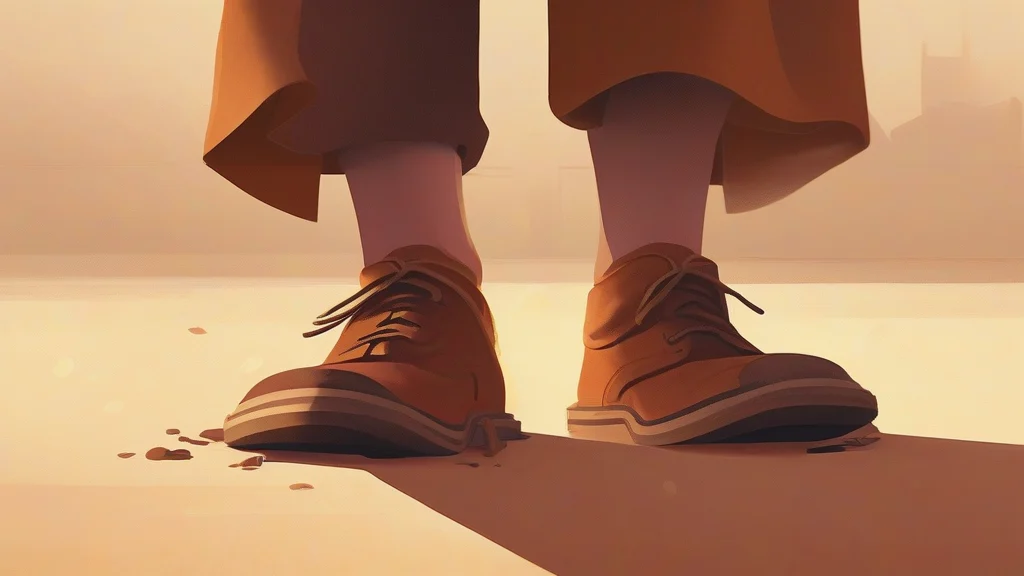
What does unshoed mean?
Unshoed means without shoes: it describes bare feet, a barefoot person, or someone who has gone without footwear. In its older or more literary use, it can also be the past tense or past participle of unshoe, as in “the groom unshoed the horses.” The adjective carries a slightly poetic or traditional quality, so it often appears in descriptions of walking, dancing, or working with bare feet, while the everyday word is barefoot. The expression can suggest vulnerability, simplicity, closeness to nature, or freedom from ordinary formality, though those implications are contextual rather than inherent. Unshoed is useful because it states the absence of footwear with unusual vividness and historical flavour. It is less common in routine conversation than barefoot, but readily understood, and the related form unshod offers a more compact, similarly literary alternative.
Without shoes; barefoot.
"He entered the soft grass with unshoed feet."
A literary or poetic adjective, less frequent in ordinary speech than barefoot.
Having removed the shoes from someone or something; used as the past tense or past participle of unshoe.
"The stable hand unshoed the horses one by one."
This verbal use is uncommon and has a traditional or literary tone.
When not wearing shoes sounds almost like poetry: unshoed.
Reviewed by Deb Chak, Editor. AI-assisted content curated by RJS Tech Solutions LLP.
Where does unshoed come from?
Unshoed is an English formation combining the prefix un-, expressing negation or reversal, with shoe; the root ultimately comes from Old English scō. The verb unshoe and its participial form unshoed were established by the early modern period, with unshoed eventually used both adjectivally and as a past form. The root has cognates in languages such as German through Schuh and Dutch through schoen, while shoemaker, shoeless, and shoeing are related English formations.
How unshoed is actually used
The adjective is literary or poetic rather than common in everyday speech, where barefoot is usually preferred. Its verbal use, as the past tense or past participle of unshoe, is also uncommon.
Easily confused with unshoed
Both words mean without shoes, but unshod is the older, more literary form, whereas unshoed uses the more transparent -ed formation.