
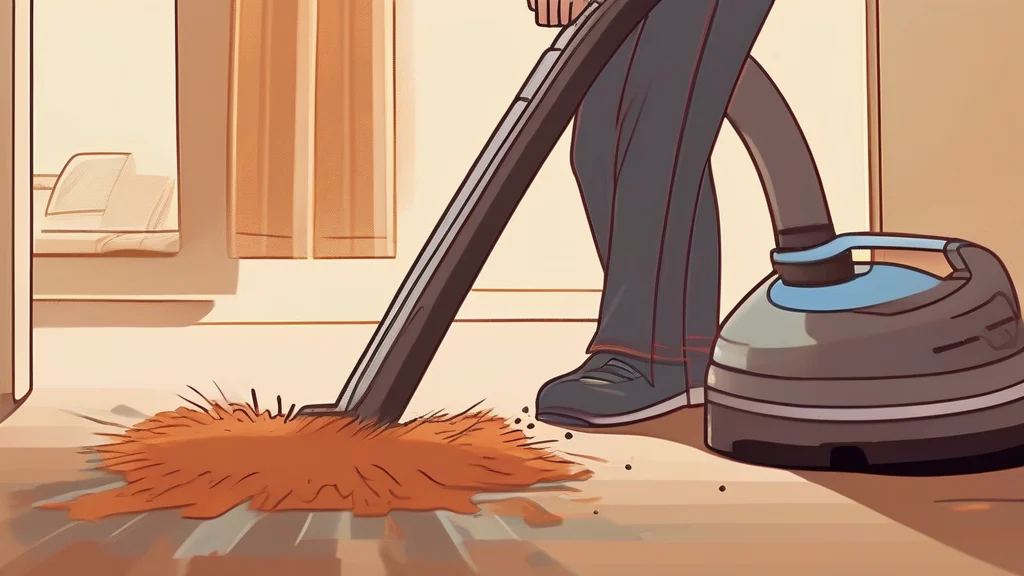
What does vacuuming mean?
Vacuuming is the act of cleaning by drawing dust and small debris into a vacuum cleaner through suction. The word is especially associated with floors, carpets, rugs, and furniture, although industrial and commercial vacuums can be used on many other surfaces. In ordinary British and American English, vacuuming is typically an everyday household activity: someone may vacuum after sweeping, before receiving visitors, or as part of a regular cleaning routine. The word is also useful in descriptive and professional contexts, such as museum maintenance, office cleaning, or allergy control. Its -ing form naturally emphasizes an activity in progress, while the related noun use refers to the activity as a whole. Although vacuuming sounds modern because of the household vacuum cleaner, its vocabulary roots are older: the central word comes from Latin, where it originally represented an empty space.
To clean a surface by removing dust and debris with a vacuum cleaner.
"I vacuumed the hallway before the children came home."
This is the dominant modern sense and is standard in both British and American English.
The activity of cleaning with a vacuum cleaner.
"The vacuuming was finished before the office opened."
This gerund use is less common than the verbal use and is normally treated as a mass noun.
The plural is rare; vacuuming is normally treated as a mass noun.
"The vacuumings were scheduled for Monday and Tuesday."
Vacuum comes from the Latin word for “empty,” so vacuuming is literally a form of emptying by suction.
Reviewed by Deb Chak, Editor. AI-assisted content curated by RJS Tech Solutions LLP.
Where does vacuuming come from?
Vacuuming is formed from the English noun and verb vacuum by adding the present-participle and gerund suffix -ing. Vacuum entered English in the 16th century from Latin vacuum, “an empty space,” the neuter form of vacuus, meaning “empty.” The same Latin family includes vacuous, vacuity, and vacate, while the development of powered suction cleaners in the early 20th century made vacuuming a familiar name for an everyday household activity.
Related word forms
How vacuuming is actually used
The form is most often used for domestic cleaning, but it is also appropriate in professional, institutional, and descriptive contexts. It is especially natural for an activity in progress, as in “I am vacuuming the bedroom.”
Easily confused with vacuuming
Vacuuming is the activity of cleaning with suction, whereas a vacuum can be the cleaning device, an empty space, or the verb meaning to clean with suction.