
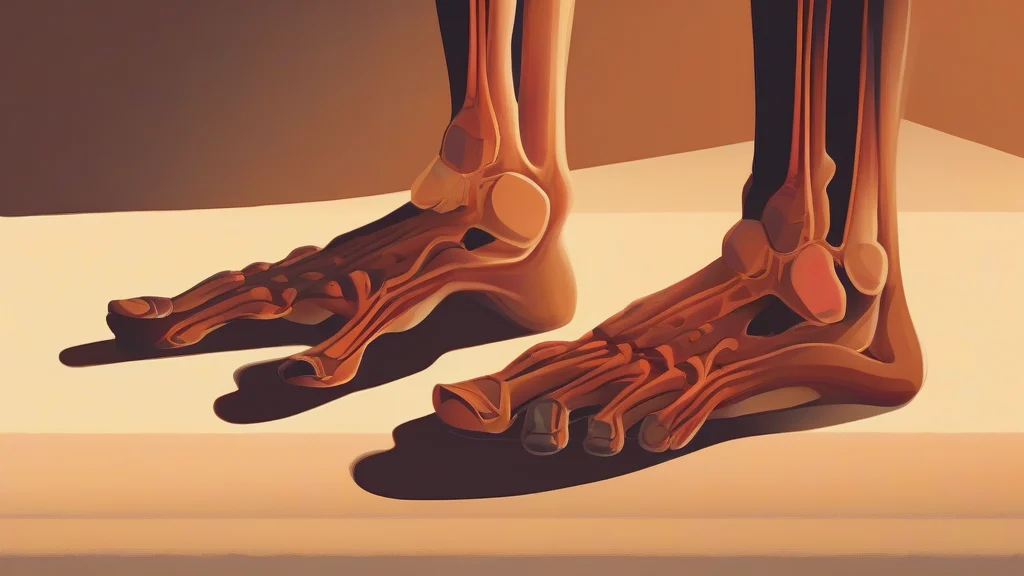
What does valgus mean?
Valgus describes an outward deviation of part of a limb from the body's midline, especially at a joint. As a noun, it refers to such a deformity; as an adjective, it characterizes the alignment or force involved. The term is especially common in orthopaedics and podiatry, where “valgus deformity” is a general description and “hallux valgus” specifically denotes an outward deviation of the great toe at the first metatarsophalangeal joint. Valgus alignment is not limited to the foot: it can occur at the knee, ankle, wrist, or other joints. The opposite condition is varus, in which the affected part angles inward toward the midline. Valgus can also describe biomechanical stress that opens a joint on its outer side. Although often encountered in technical writing and everyday discussion of bunions, it remains a specialised medical term rather than general conversational vocabulary.
A deformity in which the distal part of a limb deviates outward from the body's midline, usually producing an abnormal angle at a joint.
"The patient was referred to a specialist because of a severe valgus deformity."
The countable form is uncommon in general usage; medical writers more often use “valgus deformity” or name the affected condition, such as “hallux valgus.”
Denoting an outward deviation from the body's midline, especially at a joint.
"The test applied valgus stress to the knee to assess the integrity of its ligaments."
Chiefly medical and biomechanical, including references to alignment, deformity, force, or stress.
Rare as a standalone plural; “valgus deformities” is the usual and more natural phrasing in medical writing.
"The examination identified two valguses, one in each foot."
A bunion at the base of the big toe is a familiar sign of hallux valgus—and the name comes from the Latin for "bow-legged."
Reviewed by Deb Chak, Editor. AI-assisted content curated by RJS Tech Solutions LLP.
Where does valgus come from?
English borrowed valgus from Latin, where valgus meant “bow-legged” or “bent outward”; the word entered English usage in the early 17th century. Its ultimate origin is commonly traced to the Proto-Indo-European root *wel-, meaning “to turn” or “bend,” which also underlies cognates such as volume, vault, and volley.
Related word forms
How valgus is actually used
Chiefly used in medical, orthopaedic, anatomical, and biomechanical contexts. It is technical rather than conversational and commonly occurs as a modifier or within established medical compounds.
Easily confused with valgus
A valgus deformity angles away from the body's midline, whereas a varus deformity angles toward it.