
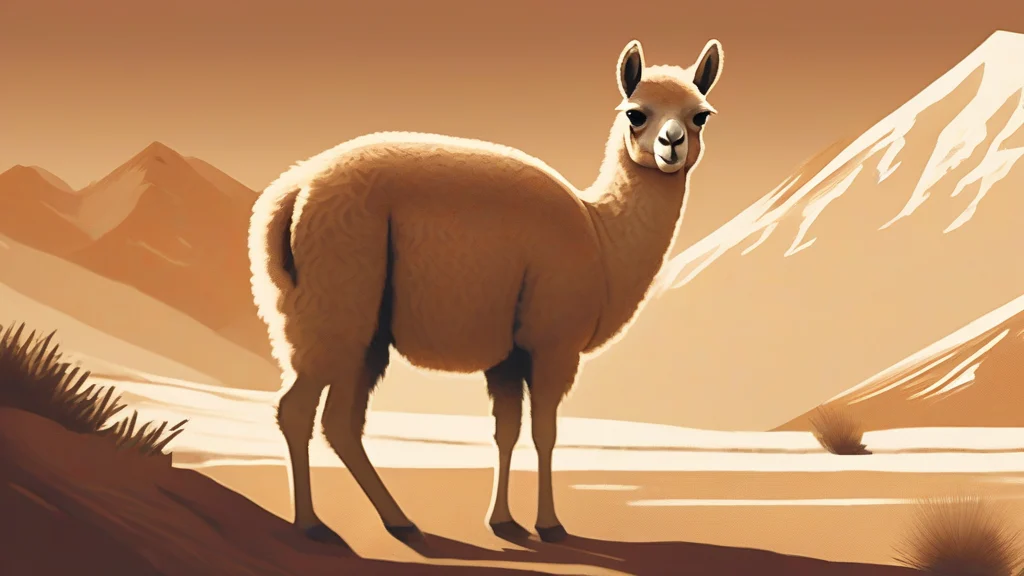
What does vicuna mean?
Vicuna denotes both a small, slender camelid native to the Andes and the exceptionally fine wool obtained from its coat. Wild vicuñas live in the mountainous regions of Peru, Bolivia, Chile, and Argentina, where their golden-brown coats provide camouflage and insulation against severe cold. Their hair is valued for being soft, lightweight, warm, and notably fine, making vicuña fabric among the most luxurious natural textiles. Historically, the Incas used vicuña wool in garments reserved for the emperor and high-ranking nobles. Heavy hunting for its fleece brought the species close to extinction during the twentieth century, but coordinated conservation and carefully regulated harvesting helped produce a substantial recovery. In modern English, vicuna is used both for the animal and for fibre or cloth made from it. It should not be confused with an alpaca, a larger domestic camelid with a coarser coat, or a guanaco, its larger wild relative. The spelling without an accent is common in English, though the Spanish-derived spelling vicuña is also recognized.
nounA vicuña is a small South American camelid, native to the Andes, with a delicate body and an exceptionally fine, soft coat. The word also denotes wool or fabric made from the animal's hair.
- A small camelid native to the high Andes of western South America, valued for its fine, lustrous coat.
- The fibre obtained from a vicuña's coat, or fabric woven from that fibre.
"The vicuña shook its fine, tawny coat before the herders prepared to shear it."
"Wild vicuñas grazed among the high grasslands of the Andes."
"Her antique coat was lined with a remarkably soft vicuña fabric."
Both the animals and the textile sense use the regular plural vicuñas.
"Several vicuñas stood alert on the ridge above the valley."
Hunted almost to extinction for its exquisite fleece, the vicuña became a major conservation success, though its wild population remains dependent on careful protection.
Reviewed by Deb Chak, Editor. AI-assisted content curated by RJS Tech Solutions LLP.
Etymology of vicuna
The English word came through Spanish vicuña. Spanish borrowed the term from Quechua, commonly transcribed as wiküya or wikuya, referring to the animal. Its ultimate Quechua etymology is uncertain, and proposed analyses of its internal structure are not sufficiently secure to state as fact.
How vicuna is actually used
The English spelling is usually written without the Spanish diacritic, although vicuña is also accepted. The plural is vicuñas. The textile sense may refer either to the animal's hair or to fabric made from it.
Easily confused with vicuna
Vicuñas are smaller and have finer, shorter hair, whereas alpacas are larger domestic camelids generally known for thicker, coarser fleece.
A guanaco is a larger wild camelid and the vicuña's closest relative, but it has a coarser coat and is not the animal whose fine fleece is called vicuña.