
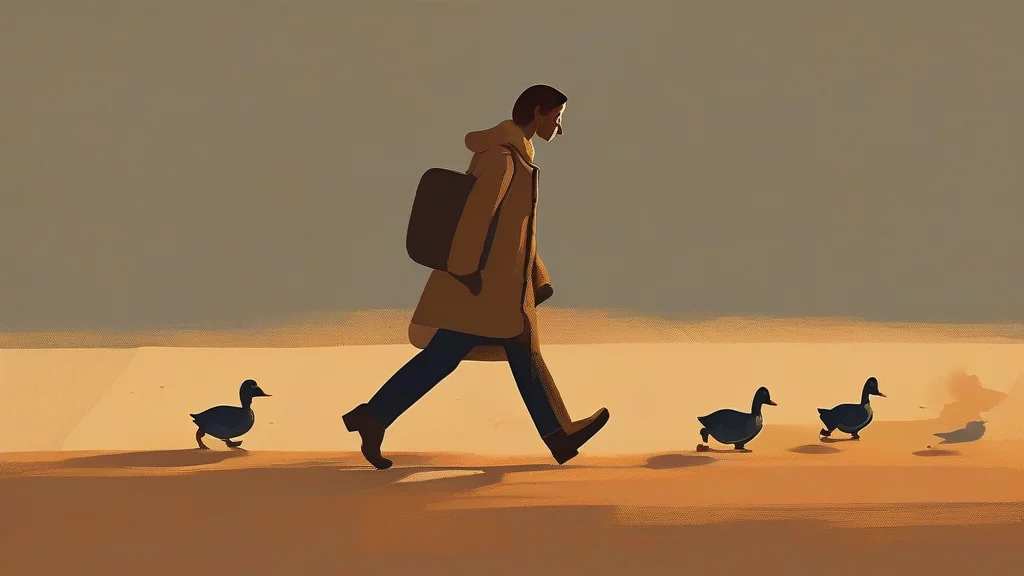
What does waddler mean?
Waddler is a noun for a person or animal that moves by waddling, using short, uneven steps and a characteristic side-to-side motion. It is especially apt for ducks and other birds, although it can also describe a person humorously or descriptively. Waddler is also the third-person singular present form of the verb waddle: “the duck waddlers toward the pond.” The noun can sound informal and playful, often emphasizing an ungainly but purposeful walk rather than movement that is merely slow. In many ordinary contexts, a more direct expression such as waddling duck or waddling child may be preferable. The word is nevertheless useful as a compact label for a recognizable performer of that movement. Its regular formation from waddle by adding the agent suffix -er makes its meaning transparent: a waddler is, quite literally, someone or something that waddles.
A person or animal that moves with short, uneven steps, typically with a side-to-side motion.
"The little penguin was a comical waddler as it crossed the beach."
Commonly used for ducks, penguins, and other birds; when applied to people, it is usually descriptive or humorous.
The third-person singular present form of waddle.
"The duck waddler across the yard with a quacking call."
This is an inflected form of waddle rather than a separate lexical verb.
The regular plural is formed by adding -s.
"A group of lively ducklings proved to be enthusiastic waddlers."
Move the “le” of waddle to the end, and the person doing the waddling becomes a waddler.
Reviewed by Deb Chak, Editor. AI-assisted content curated by RJS Tech Solutions LLP.
Where does waddler come from?
Waddler was formed from waddle with the agentive suffix -er. Waddle is attested from the early 17th century and is commonly traced, with some uncertainty, to Middle English wadel, meaning to wade, and Old English wædel, referring to shallow water or a ford. The related words wade and wader belong to the same Germanic word family.
How waddler is actually used
The noun is relatively uncommon and often mildly humorous or descriptive, especially when applied to a person. The verb form is an ordinary inflection and follows third-person singular agreement.