
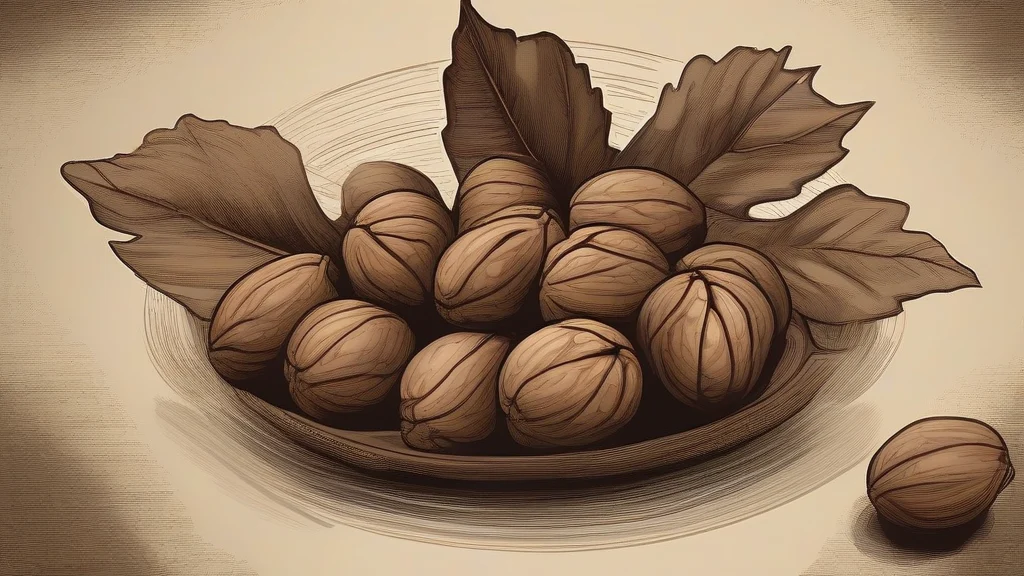
What does walnut mean?
Walnut most commonly denotes the edible seed of a walnut tree, a food valued for its rich, slightly bitter flavor and used in salads, sauces, pastries, and traditional sweets. The word can also refer to the tree that produces the seed or to its hard, dark wood, which is prized for furniture, cabinetry, and ornamental objects. Walnuts occur in many varieties, with English and black walnuts among the best-known, and their flavor and appearance vary by species and origin. Botanically, a walnut fruit is a drupe rather than a true nut: it has a fleshy outer husk surrounding a hard shell and an edible kernel. In British and American English, the word is widely understood in all these senses. The adjective “walnut” describes the dark brown color of a walnut shell, and a rare verb use means to beat or strike with a walnut.
The edible seed of a walnut tree, the tree itself, or the hard, dark wood obtained from it.
"Roasted walnuts make a crisp topping for a green salad."
The reference varies with context: culinary and botanical uses generally concern the seed or tree, while furniture-making usually concerns the wood.
Of the dark brown color of a walnut shell.
"The room was painted a warm walnut color."
This use is common in descriptions of hair, furniture, paint, and other finishes; British and American spellings conventionally differ in “coloured” and “colored.”
To beat or strike with a walnut.
"The comic character threatens to walnut the children who misbehave."
This is a rare and chiefly humorous verb use.
The plural is formed by adding -s and is used for individual seeds, trees, or discrete pieces of walnut material.
"The recipe calls for two cups of chopped walnuts."
A walnut is not botanically a true nut but a drupe: a fleshy fruit surrounding a hard shell and its edible seed.
Reviewed by Deb Chak, Editor. AI-assisted content curated by RJS Tech Solutions LLP.
Where does walnut come from?
English “walnut” comes from Old English forms such as hwalhutu and hwalhnutu, which developed from a Proto-Germanic word commonly reconstructed as *walhnut-. The precise origin of that ancestral word is uncertain, although proposals have linked it with elements associated with foreignness or with the tree’s wood. Its relatives include German Walnuss and Dutch walnoot, which preserve cognate forms of the same inherited compound.
Related word forms
How walnut is actually used
The word is generally neutral and is used in culinary, horticultural, woodworking, and decorative contexts. British English commonly uses the spelling “walnut-coloured,” while American English typically uses “walnut-colored.”
Easily confused with walnut
A butternut is a type of walnut with a pale, elongated kernel, whereas a walnut generally refers to the seed or tree without identifying that particular variety.