
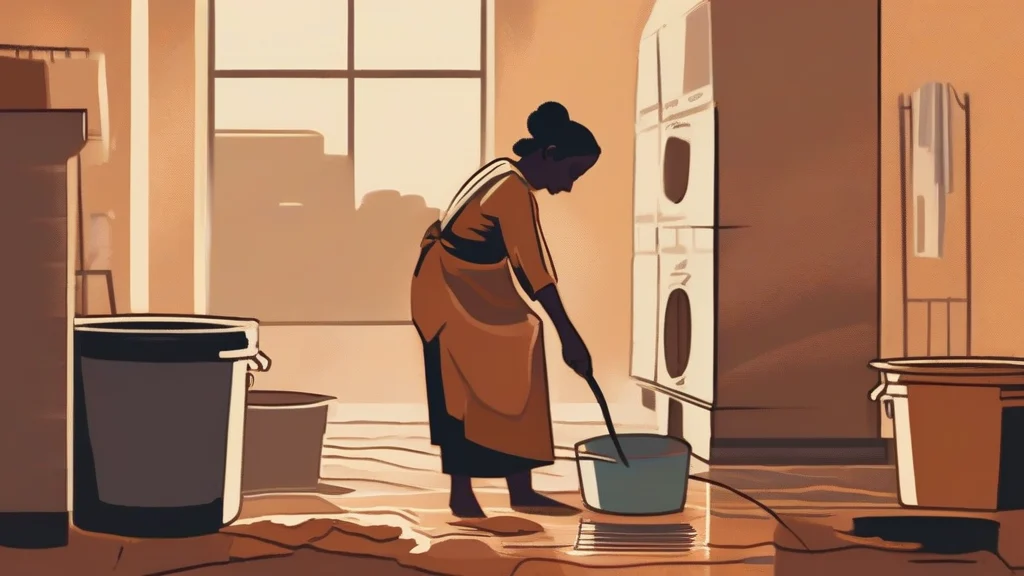
What does washerwoman mean?
Washerwoman is a noun for a woman employed to wash clothes, household linens, or other fabrics. It is especially associated with a period when laundry was commonly done by hand, in a home, an institutional washhouse, or a commercial laundry. The word can therefore suggest both an occupation and the physical labor involved in cleaning heavy bedding, clothing, and other textiles. In modern English, it sounds dated and is most common in historical novels, archival records, biographies, and accounts of working life. “Laundry worker” is generally more neutral for present-day contexts, while “laundress” is the closest familiar alternative. Although the expression is often encountered in British and American writing, it is not a regional form in normal use. Its main lasting interest lies in preserving the name of a recognizable pre-industrial occupation and the social history of women’s unpaid and paid domestic labor.
nounA woman employed, especially formerly, to wash clothes and household linens. The term is now chiefly historical or literary.
- A woman employed to wash clothes, linens, or other fabric, especially in a domestic or institutional laundry.
"The washerwoman returned the linen steaming and neatly folded."
"A washerwoman waited beside the copper tub while the boiling linen was lifted from it."
"The census records her occupation as a washerwoman in the large commercial laundry."
The plural is irregular, formed by changing “-man” to “-women.”
"The washerwomen worked together beside the communal wash tubs."
Washerwoman preserves a pre–washing-machine job title for the woman whose daily labor kept households and institutions supplied with clean linen.
Reviewed by Deb Chak, Editor. AI-assisted content curated by RJS Tech Solutions LLP.
Where does washerwoman come from?
“Washerwoman” is an English compound formed from “washer” and “woman.” “Washer” derives from “wash” plus the occupational suffix “-er,” while “woman” continues Old English wīfmann, a compound meaning “female human.” The modern occupational term developed in English as washing became established as a regular paid occupation.
How washerwoman is actually used
The word is old-fashioned and survives mainly in historical, literary, and biographical contexts. In contemporary usage, “laundry worker” is more neutral and descriptive.
Easily confused with washerwoman
A washerwoman is a woman who washes clothes or linens, while a washerman is the corresponding male worker.