
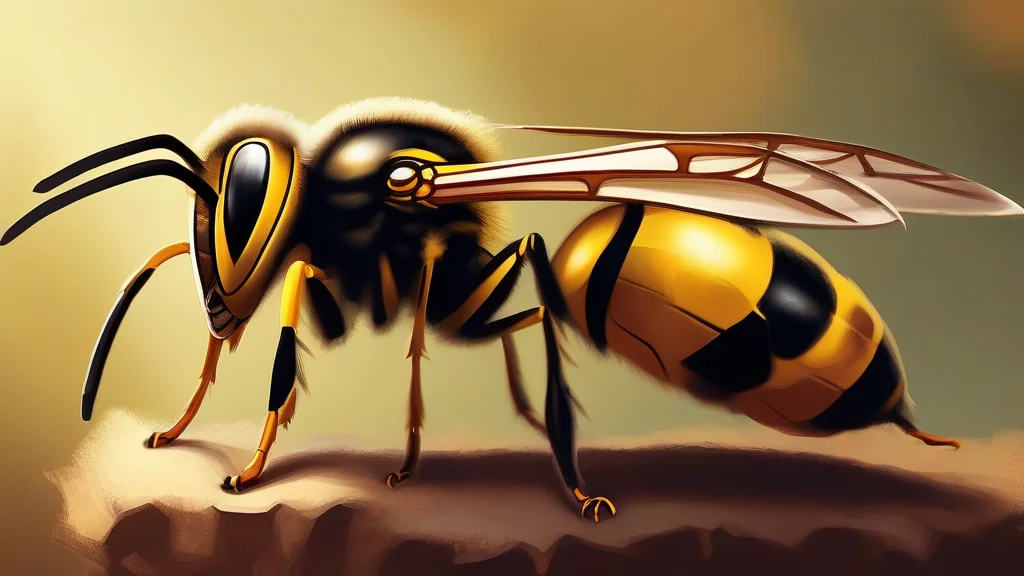
What does wasp mean?
A wasp is a winged insect in the order Hymenoptera, the group that also includes bees, ants, and sawflies. Most wasps have a constricted waist, two pairs of wings, and females equipped with a stinger. They are usually solitary, though some species, such as paper wasps, live in social colonies with a queen and workers. The word can also be used figuratively for an irritable or spiteful person, though this sense is uncommon and may sound harsh or outdated. In everyday conversation, “wasp” is often treated as a general term that includes several superficially different insects, including hornets and yellow jackets, although these are more specific kinds of wasps. The word is especially useful when discussing the wasp’s distinctive narrow waist, its often aggressive defense of a nest, and the contrast between solitary and social species.
nounA winged insect of the order Hymenoptera, typically with a narrow waist and a sting. Figuratively, the word can refer to an irritable or spiteful person.
- A winged, stinging insect with a typically narrow waist.
- A person regarded as irritable, spiteful, or quick to anger.
"A paper wasp built its nest beneath the garden eaves."
"A paper wasp built its nest beneath the garden eaves."
"He snapped at every question, like a wasp."
The standard plural is “wasps”; it is used for both individual insects and groups of the insects.
"A swarm of wasps gathered around the fallen fruit."
Unlike a honeybee, a wasp generally has a smooth stinger and can sting repeatedly.
Reviewed by Deb Chak, Editor. AI-assisted content curated by RJS Tech Solutions LLP.
Where does wasp come from?
The English word comes through Middle English from Old English wæps, which is generally traced to a Germanic root related to *waps-. The Latin word vespa, meaning “wasp,” is a cognate and is the source of scientific forms such as vespid and vespula. Modern English retained the older consonant pattern while standardizing the spelling as “wasp.”
Related word forms
How wasp is actually used
The figurative sense is uncommon and often derogatory, so it may sound insulting or dated. The capitalized acronym “WASP” is a separate usage and should not be confused with the ordinary noun.
Easily confused with wasp
Lowercase “wasp” names the insect, while the all-capital acronym “WASP” usually stands for white Anglo-Saxon Protestant.