
What does waterbuck mean?
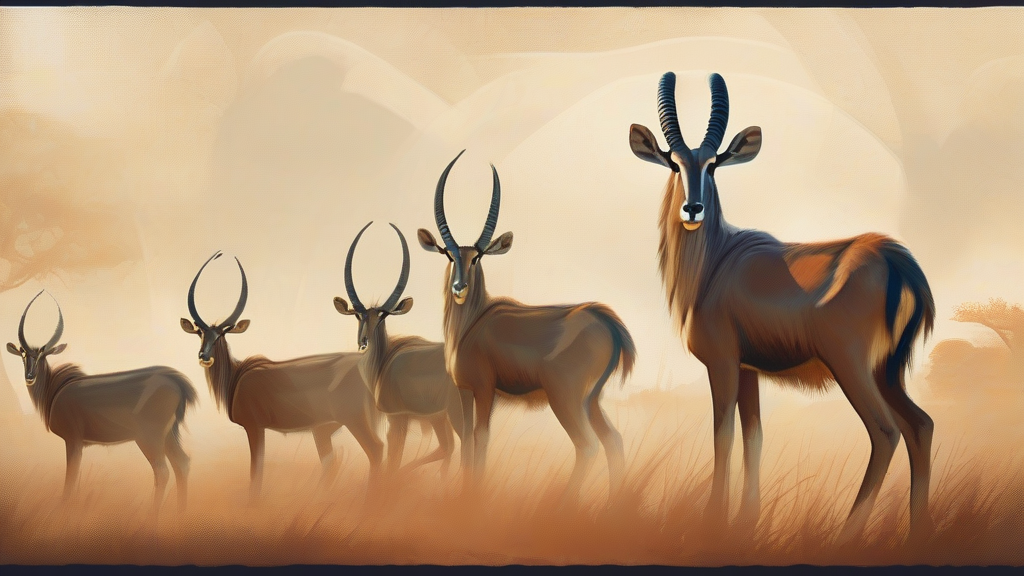
A waterbuck is a large African antelope, most commonly referring to the species Kobus ellipsiprymnus, which occurs in savannas, woodlands, and wetlands across sub-Saharan Africa. Its coloration varies from reddish brown to gray, and adult males possess conspicuous, heavily ridged horns that curve backward and then upward; females normally have no horns. The animal is often seen in herds near rivers and other sources of water, an association that contributes to its name. English uses “waterbuck” chiefly in zoological, conservation, and wildlife-tourism contexts. In most current usage, the unmodified word means the common waterbuck, although related species in the genus Kobus may also be discussed in specialist literature. Its standard plural is “waterbucks.” The word is useful because it names a familiar African antelope precisely without being a general term for all antelope or for the unrelated water buffalo.
nounA large African antelope, especially the common waterbuck (Kobus ellipsiprymnus), found in savannas, woodlands, and wetlands near water. Males have long, ridged horns that curve backward and then upward, while females generally lack horns.
- The common waterbuck, a large antelope of the genus Kobus native to sub-Saharan Africa, especially the species Kobus ellipsiprymnus.
"A herd of waterbuck grazed on the green banks of the river."
"The safari stopped when a herd of waterbuck appeared beside the watering hole."
"Wildlife researchers used the waterbuck population to monitor the health of the wetland ecosystem."
The regular English plural of the noun is “waterbucks.”
"Large herds of waterbucks migrate between the grazing areas."
Its name is wonderfully literal: the waterbuck became so closely associated with water that it carried the name in its very first word.
Reviewed by Deb Chak, Editor. AI-assisted content curated by RJS Tech Solutions LLP.
Etymology of waterbuck
“Waterbuck” is an English compound formed from “water” and “buck,” both of which have Old English origins and Germanic cognates. “Water” continues Old English wæter and is related to Dutch water and German Wasser, while “buck” continues Old English buc and is related to Dutch bok and German Bock. The compound name reflects the waterbuck’s traditional association with water and the places where it is commonly found.
How waterbuck is actually used
In modern wildlife usage, the unmodified term usually denotes the common waterbuck. It is a standard zoological noun rather than a regional form of speech, though it is encountered chiefly in descriptions of African wildlife and safari travel.
Easily confused with waterbuck
A waterbuck is an African antelope, whereas a water buffalo is a large domesticated bovine native to Asia.
A kob is a member of the broader genus Kobus, while waterbuck usually refers specifically to the common waterbuck.