
What does watering mean?
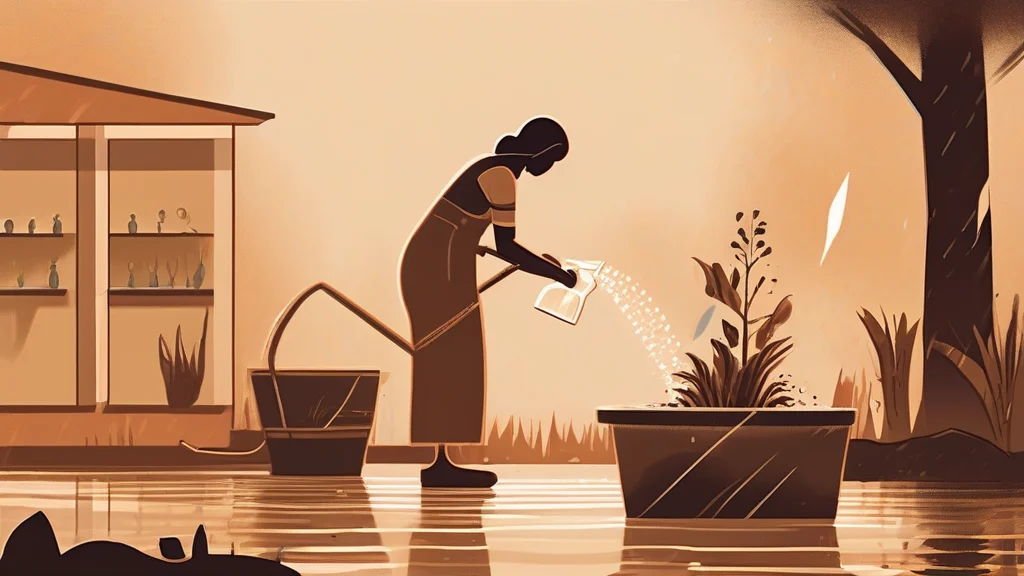
Watering usually means supplying water to plants, soil, or animals. It is the present-participle and gerund form of the verb “water,” and it is especially common in gardening, agriculture, and descriptions of everyday household tasks: a person might water the garden before leaving for work or use a watering can on a row of seedlings. In another sense, watering means adding water to a liquid or substance to dilute it. This usage is especially familiar from the phrase “watering down,” meaning to weaken a drink, message, or proposal by adding liquid or removing its strength. As a noun, watering denotes the activity or process of supplying water, though it is normally used in this way as a gerund and is often treated as uncountable. The word has no strong regional or formal restrictions in British or American English. Its usefulness lies in expressing a familiar, recurring action that is central to plant care and also participates in idiomatic expressions with contrasting ideas of nourishment, dilution, and weakening.
To give water to plants, soil, animals, or another object; to add water to something in order to dilute it.
"They watered the young trees every morning during the dry spell."
The dilution sense is especially common in the phrasal expression “water down.”
The act or process of supplying water, especially to plants or soil; the addition of water to dilute something.
"Regular watering kept the vegetable patch in good condition."
Usually uncountable and commonly used with gardening or agricultural modifiers such as “overwatering” and “underwatering.”
Rare; “watering” is normally treated as an uncountable noun, although plural “waterings” can refer to separate occasions of watering.
"The garden's early waterings were enough to establish the seedlings."
A watering hole originally meant a place where animals could drink; today, it often means a pub or bar, while a watering can still helps the plants thrive.
Reviewed by Deb Chak, Editor. AI-assisted content curated by RJS Tech Solutions LLP.
Where does watering come from?
“Watering” was formed from “water” by adding the present-participle and gerund ending “-ing.” “Water” comes from Old English “wæter,” which was inherited from Proto-Germanic “watōr” and ultimately from the same Indo-European root reflected in Latin “aqua” and Greek “hydōr.” The formation with “-ing” follows the ordinary English pattern for expressing an ongoing action, and the noun sense developed naturally from the verb.
Related word forms
How watering is actually used
The word is neutral and widely used in everyday British and American English. “Watering” is less technical than “irrigation” in a domestic context but is also used in professional descriptions of gardens, crops, and public landscaping. In the expression “watering down,” it has the more specialized meaning of diluting or weakening something.