
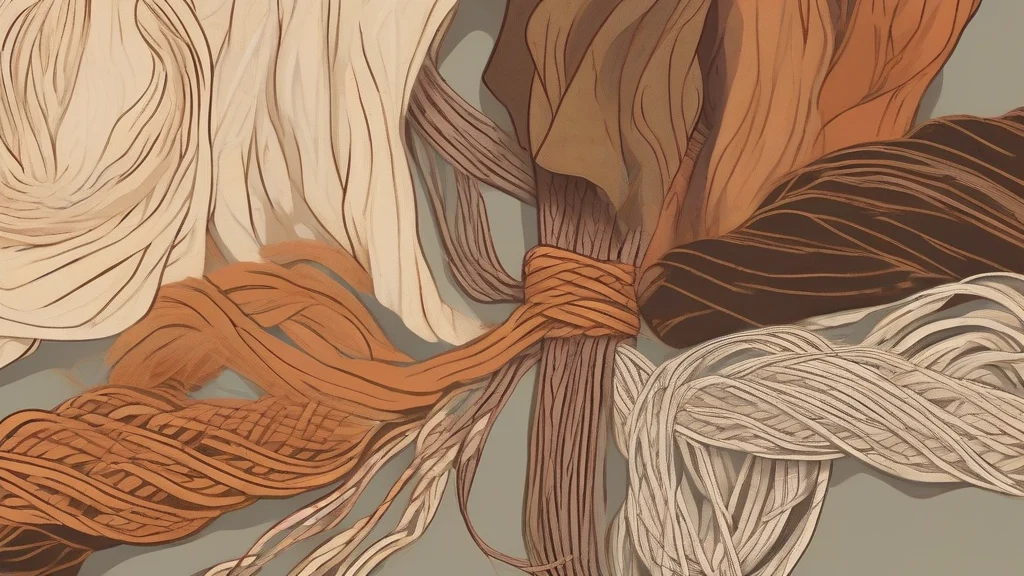
What does weaving mean?
Weaving is the activity of making fabric, baskets, rugs, and other objects by interlacing threads, usually across a loom. As a noun, it can refer either to the process itself or to a woven material or finished work. As a verb, it describes the action of crossing and tightening threads, and it is frequently used figuratively for combining ideas, stories, or movements through a complex sequence. The word often suggests patience, continuity, craftsmanship, and careful structure: a woven object depends on many connected strands. In literary and analytical contexts, weaving can evoke the gradual joining of separate elements into a coherent whole. Although weaving has practical and artistic associations, the word is also widely understood as an ordinary gerund, as in 'she was weaving,' without any specialized meaning.
The process or technique of making fabric or other structures by interlacing threads; also a woven material or object.
"The village was known for its weaving of fine, colourful textiles."
When referring to a specific woven artwork or product, 'a weaving' is possible, though it is less common than the ordinary collective sense.
To interlace threads, especially on a loom, or figuratively to combine or move through separate elements.
"She spent the afternoon weaving strips of coloured wool into a basket."
This is the gerund and present-participle form of weave; it is common both as an action in progress and as the first element of a compound noun.
The plural is uncommon and normally refers to separate woven works or products.
"The exhibition featured several delicate weavings by local artisans."
Weaving turns separate threads into fabric—and, in figurative language, separate ideas into stories.
Reviewed by Deb Chak, Editor. AI-assisted content curated by RJS Tech Solutions LLP.
Where does weaving come from?
The noun weaving and the verbal form both derive from the English word weave. The word traces to Old English wefan, meaning 'to weave,' and related English forms include weaver, weft, and web. These words belong to an older Germanic vocabulary associated with the ancient practice of interlacing threads to create textiles and other patterned structures.
How weaving is actually used
The noun is common in both everyday and technical contexts. The verbal form is often a gerund or present participle, as in 'weaving a basket,' while figurative uses such as 'weaving a story' are common in formal writing and criticism.
Easily confused with weaving
Waiving means giving up or formally relinquishing a right or requirement, whereas weaving means interlacing threads or combining elements.