
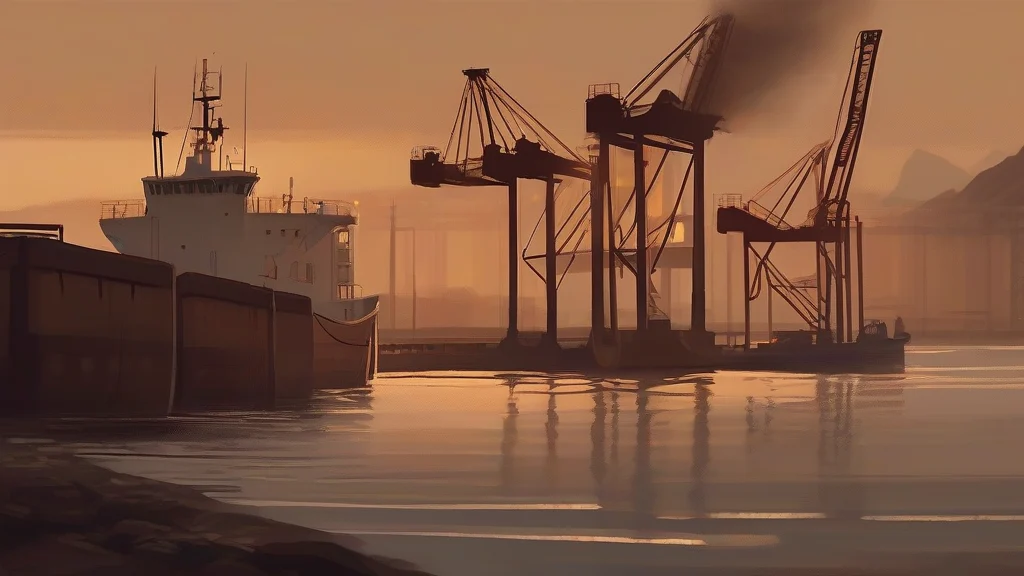
What does wharve mean?
Wharve is an obsolete English variant of wharf. It denotes a quay or landing stage beside a harbor, river, or other navigable waterway, where vessels can load and unload cargo and people can approach the water. In older writing, the spelling could occur in descriptions of ports, docks, warehouses, and maritime trade, sometimes evoking the atmosphere of a working harbor. Today it is encountered chiefly in historical sources, literary texts that reproduce an earlier register, or discussions of spelling history. It should not normally be used in modern standard English, where wharf is the accepted form. Its standard plural is wharves, despite the added final syllable in the singular. Although wharve and wharf refer to the same thing, wharve has the advantage of preserving a visible piece of the word's historical development.
nounAn obsolete variant of wharf, meaning a quay or landing place at a harbor where vessels load and unload cargo.
- An obsolete form of wharf: a quay, wharf, or landing stage beside a harbor or navigable waterway.
"At the wharve, the lightermen unloaded bales of wool from the tide-bound ship."
"The tide was high at the wharve, and the dockworkers waited for the cargo boats."
"In his account of eighteenth-century trade, the merchant describes the warehouses near the wharve."
The standard plural adds -es.
"Boats crowded around the wharves as the evening tide began to rise."
Wharve preserves the old English spelling of wharf, a reminder that familiar words can change by only one letter.
Reviewed by Deb Chak, Editor. AI-assisted content curated by RJS Tech Solutions LLP.
Etymology of wharve
Wharve was an obsolete Middle English variant spelling of wharf. The standard form traces to Old English hwearf, meaning a bank or shore, and belongs to a Germanic word family represented by such cognates as Old Norse hvarf and German Werft. Its modern sense, a landing place or quay, developed as the word was applied to maritime structures associated with the earlier meaning of a bank or shore.
How wharve is actually used
Archaic and effectively obsolete in contemporary prose, it belongs to historical texts or deliberately archaic writing rather than ordinary modern usage.
Easily confused with wharve
Wharve is an obsolete spelling of wharf; the two do not denote different objects.