
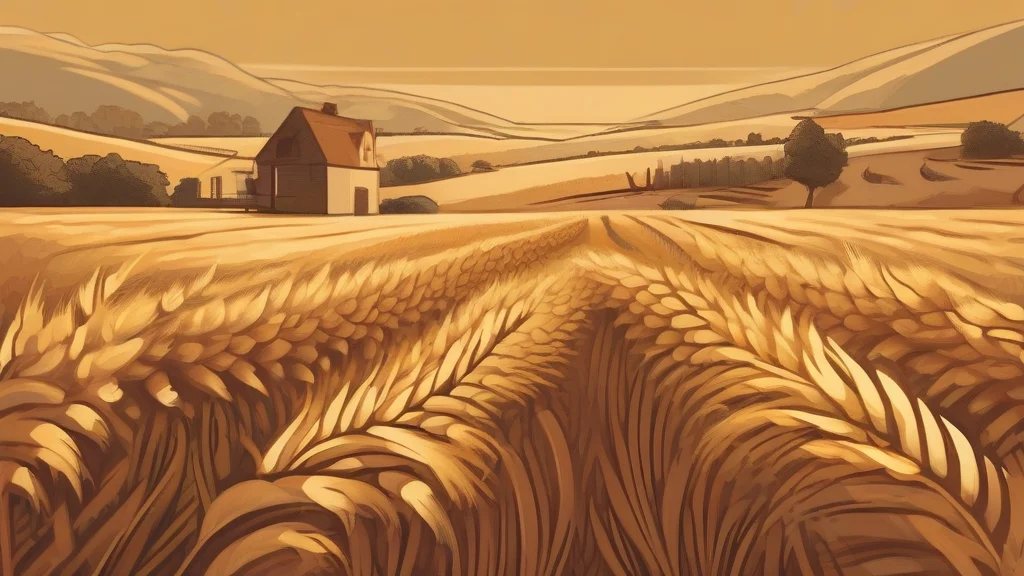
What does wheatfield mean?
A wheatfield is a field where wheat is being grown, especially one viewed as part of the rural landscape. The term is common in both British and American English and can describe a working farm field or a broad expanse of wheat-covered land. In ordinary usage, its associations are agricultural, pastoral, and seasonal, with ripe or golden wheat suggesting harvest, abundance, and the changing countryside. In literature, a wheatfield may also provide a secluded or visually dramatic setting because its tall crops can conceal people and transform the appearance of the surrounding land. The word is normally countable and takes the plural wheatfields. Although wheat field is sometimes written as two words, wheatfield is the established closed compound and is the preferred form in standard dictionaries.
nounA field in which wheat is grown. The word can also refer broadly to an expanse of wheat-covered land.
- A field planted with wheat, or an area of land covered by wheat.
"A narrow road ran between the golden wheatfields."
"The farmer walked through the wheatfield at sunset."
"In the novel, the protagonist hides in a wheatfield while the countryside searches for him."
The standard plural form is wheatfields.
"Several wheatfields bordered the road."
A wheatfield turns the horizon into a single golden expanse, making the landscape itself glow.
Reviewed by Deb Chak, Editor. AI-assisted content curated by RJS Tech Solutions LLP.
Etymology of wheatfield
Wheatfield is an English compound formed from wheat and field. Wheat continues Old English hwǣte, while field continues Old English feld; both elements are inherited from Germanic languages, and the compound has been established in English since the early modern period. Wheat is related to white through the old Germanic sense of a pale or shining grain, while field is cognate with Dutch veld and German Feld.
Related word forms
How wheatfield is actually used
A common, countable noun used in everyday and literary English in British and American varieties. It usually describes agricultural land, but literary descriptions may use it for the visual character of a wheat landscape.