
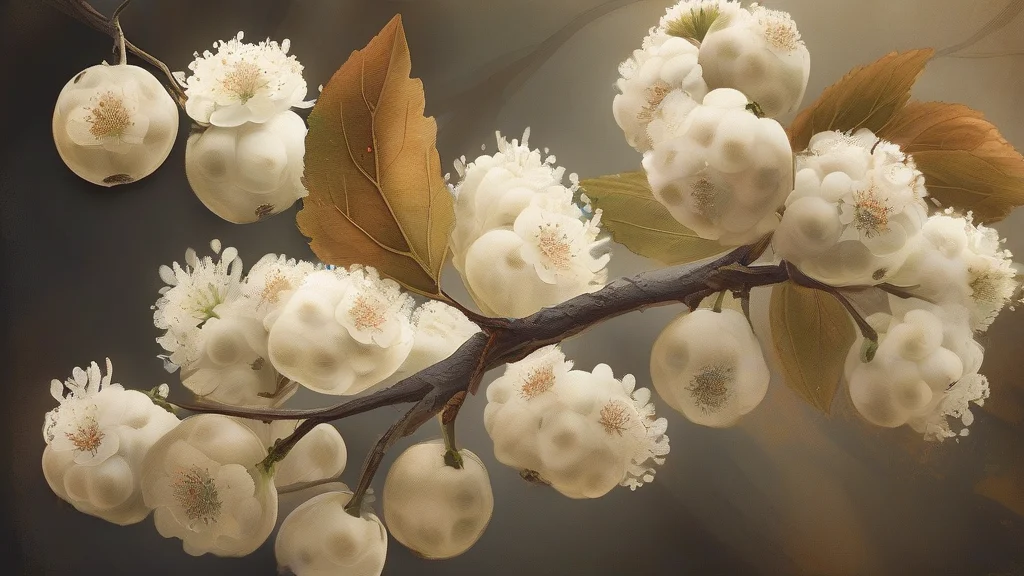
What does whitebeam mean?
Whitebeam is a deciduous tree belonging to the rose family, botanically known as Sorbus aria. It is native to much of Europe and is also widely planted as an ornamental. Its most recognizable feature is the dense white felt covering the undersides of its pinnate leaves, which gives the tree a pale or silvery appearance when wind turns the foliage. The small white flowers are followed by berries that mature to orange-red or red. In British English, whitebeam is a familiar name associated with parks, gardens, churchyards, and woodland; it is also used in North American botanical and horticultural contexts. The word is a compound of white and beam. Here, beam retains an old sense of tree, so the name describes the conspicuous whiteness beneath the leaves rather than referring to timber. Whitebeam is useful when precise identification matters because it belongs to the same broader group as other Sorbus species, including the rowan, but can be distinguished by its white-backed leaves and the color and form of its fruit.
nounA deciduous European tree of the rose family, Sorbus aria, with pinnate leaves covered with white felt beneath and small flowers followed by orange-red berries. It is also cultivated as an ornamental tree.
- The European ornamental tree Sorbus aria, distinguished by its white-felted leaf undersides and orange-red berries.
"A mature whitebeam shaded the garden wall with its silver-backed leaves."
"The whitebeam in the churchyard was heavy with clusters of orange-red berries."
"Botanists distinguish the whitebeam from other rowans by its densely felted, white leaf undersides."
The regular plural is used when referring to more than one tree, especially in plantings, collections, or landscapes.
"Two whitebeams frame the entrance to the garden."
The name is fittingly descriptive: the undersides of a whitebeam's leaves are covered in such dense white felt that they seem frosted.
Reviewed by Deb Chak, Editor. AI-assisted content curated by RJS Tech Solutions LLP.
Where does whitebeam come from?
Whitebeam is a compound of white and beam. In this botanical use, beam comes from Old English bēam, meaning a tree, and is cognate with German Baum and Dutch boom; its older tree sense underlies the compound. White derives from Old English hwit, the source of forms such as whiten and whiteness. The name refers to the white felt on the undersides of the tree's leaves.
How whitebeam is actually used
The term is standard botanical English and is especially familiar in Britain, where the tree occurs naturally. In North American horticultural usage, the name is understood but is less prominent as a common name.
Easily confused with whitebeam
Beam is the separate English word for a ray of light or a structural timber member; in whitebeam, it preserves the older sense of a tree.