
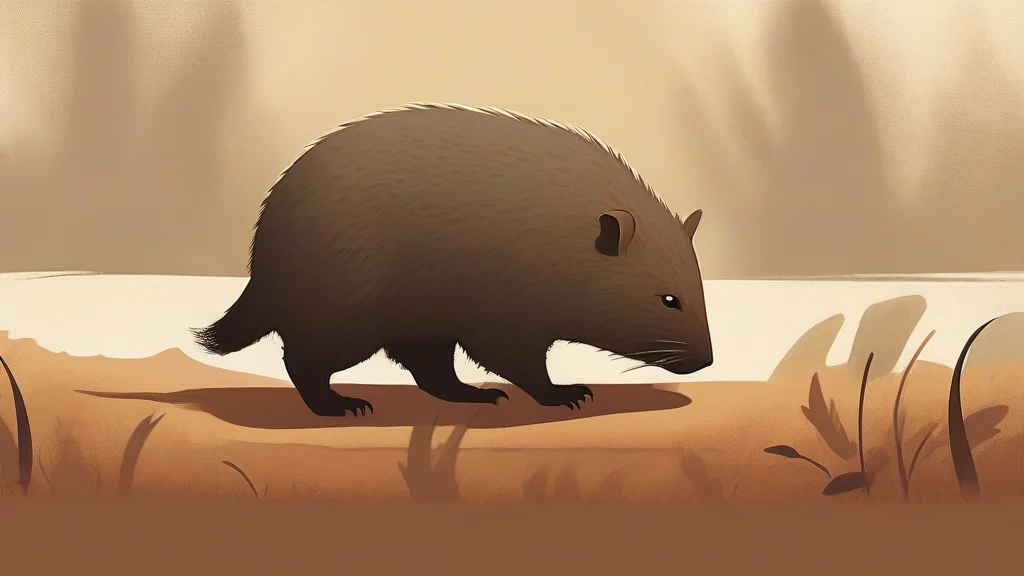
What does wombat mean?
A wombat is a short-legged, burrowing marsupial native to Australia. There are three living species: the common wombat and the northern and southern hairy-nosed wombats. Most wombats have coarse brown or gray fur, powerful claws, small ears, and a marsupial pouch, and they spend much of their time underground in elaborate burrow systems. Their diet consists chiefly of grasses, roots, and other vegetation. Wombats are also notable for producing cube-shaped droppings, a distinctive natural phenomenon whose precise function remains uncertain. The word is occasionally used informally for a lazy, sluggish, or slow-moving person, especially in Australian English, but its everyday zoological meaning is much more common. As a vocabulary word, “wombat” combines an unusual Australian origin with an easily remembered animal whose appearance, habits, and rectangular droppings make it particularly memorable.
nounA stocky, burrowing, herbivorous marsupial native to Australia, characterized by short legs, coarse fur, small ears, and a pouch in which to carry its young. Informally, the term can also refer to a person regarded as lazy or slow-moving.
- Any of the living species of stocky, herbivorous, burrowing marsupial native to Australia.
- Informally, a person considered lazy, sluggish, or slow-moving.
"A wombat emerged from its underground burrow as the sun began to set."
"The common wombat was grazing beside its burrow when the visitors approached."
"Calling him a wombat was the tour guide's way of teasing the slowest hiker in the group."
The plural is regular and formed by adding -s.
"Wombats often share overlapping burrows with other wombats."
A wombat is famous for leaving behind cube-shaped droppings—the animal equivalent of nature’s oddly precise geometry.
Reviewed by Deb Chak, Editor. AI-assisted content curated by RJS Tech Solutions LLP.
Where does wombat come from?
The English word was borrowed from Dharug, an Aboriginal language of the Sydney region, during the early colonial period, when several spellings including “wambad” and “womback” appeared in written accounts. The established form “wombat” became standard as references to the animal increased. The scientific generic name Vombatus and the family name Vombatidae preserve the same word as their ultimate source.
Related word forms
How wombat is actually used
The zoological sense is standard and neutral. The figurative sense is informal, particularly associated with Australian English, and may sound affectionate or mildly disparaging depending on context.