
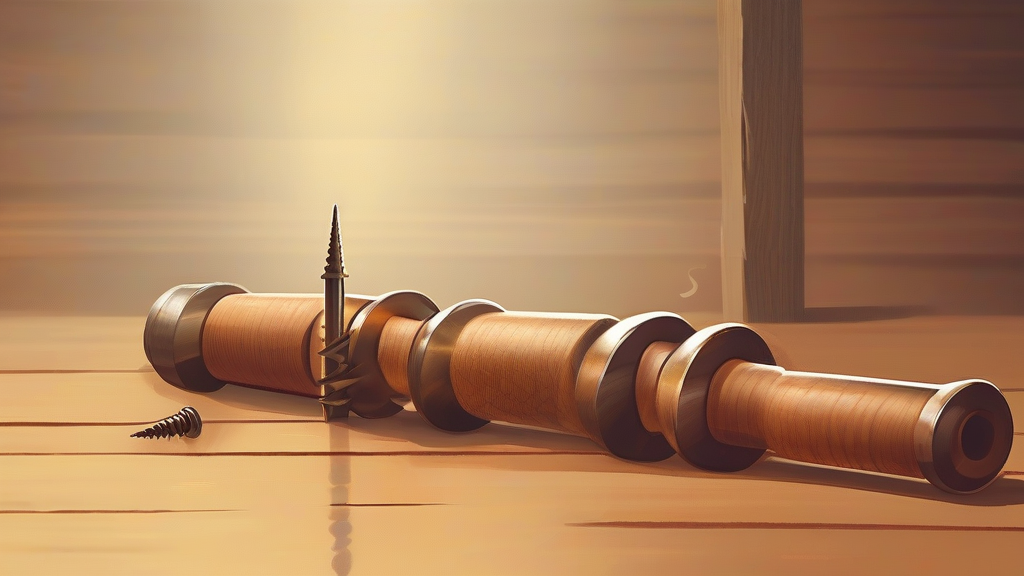
What does woodscrew mean?
A woodscrew is a screw made of wood rather than metal, traditionally used to fasten one piece of wood to another. In everyday use, the word most often refers to a screw whose shank and thread were cut from wood, especially a relatively large, coarse-threaded fastener once used in carpentry and joinery. Such screws were particularly useful where metal would have been expensive, unsuitable, or prone to rust, and examples survive in furniture, tools, structural fittings, and old buildings. Wooden screws were commonly made by specialist craftsmen using a brace and bit, with the thread formed as the wood was turned and the hole prepared with a tapered auger. Modern usage is relatively uncommon, so “wood screw” is generally clearer and more idiomatic than the closed compound “woodscrew.” Nevertheless, the term is useful in historical, conservation, and antique-restoration contexts. It can also describe traditional fasteners associated with shipbuilding and woodworking, where their strength and ability to grip wooden members made them valuable.
nounA screw made of wood, especially one used for fastening pieces of wood together.
- A screw made of wood, used to fasten wooden objects together.
"He tightened the woodscrew with an old-fashioned brace and bit."
"The old chest was held together with wooden pegs and a single woodscrew."
"He turned the woodscrew until the loose panel sat flush against the frame."
Pluralized by adding -s when referring to individual wooden screws.
"Several woodscrews held the drawer together."
Before steel screws became ubiquitous, builders made their own fasteners from carefully shaped wood.
Reviewed by Deb Chak, Editor. AI-assisted content curated by RJS Tech Solutions LLP.
Etymology of woodscrew
“Woodscrew” is a closed compound formed from “wood” and “screw,” both of which are of Germanic origin. “Wood” comes through Old English from Proto-Germanic *wudaz, while “screw” entered English from Old English scrūa or a related continental form, ultimately tracing to Latin *scribō, “to write or draw.” The compound developed as a practical name for a wooden fastener. It belongs to a broader English family of “wood” compounds, including “woodwork,” “woodworm,” and “woodsman,” though it does not have a directly corresponding cognate in other languages.
How woodscrew is actually used
The closed spelling “woodscrew” is uncommon in modern English; “wood screw” is the conventional form. The term can sound old-fashioned, though wooden screws remain useful for tasks involving delicate or antique wooden objects.
Easily confused with woodscrew
“Woodscrew” is the closed compound, while “wood screw” is the more usual two-word spelling of the same kind of fastener.