
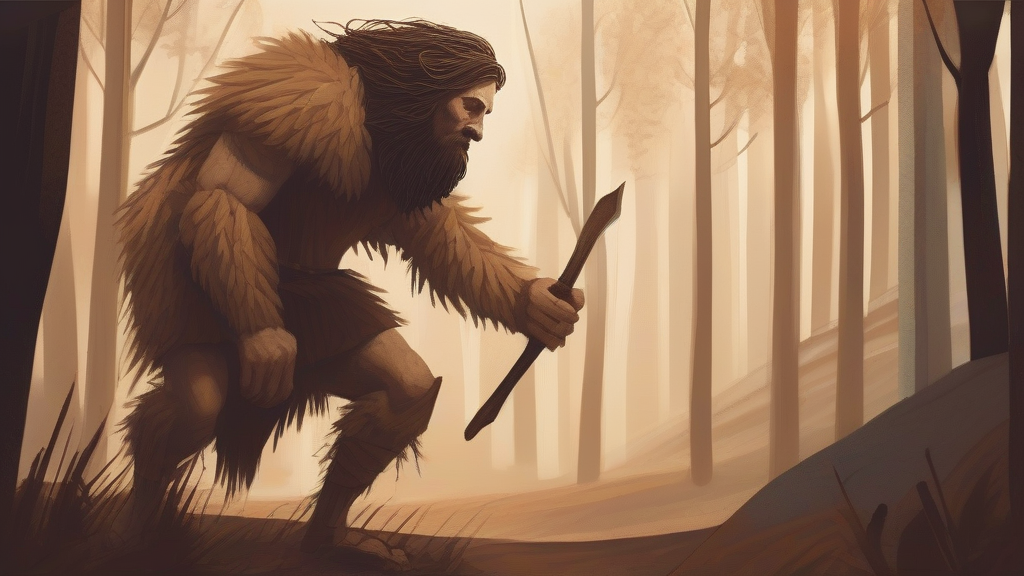
What does woodwose mean?
Woodwose is an archaic English noun for a wild, hairy man or a grotesque figure associated with the forest, especially in medieval folklore and later literature. Rather than naming an ordinary woodland creature, the word evokes the “wild man”: a solitary or untamed inhabitant of the woods, often portrayed as physically strange and morally or culturally outside settled society. Literary writers may also use it metaphorically for someone imagined as primitive, uncivilized, or resistant to social convention. The term is uncommon in contemporary speech and is generally best reserved for historical, literary, or deliberately antiquarian contexts. Its distinctive sound and old-fashioned imagery make it useful when discussing medieval romance, Renaissance allegory, folklore, or the tradition of the wild man. In Edmund Spenser's The Faerie Queene, the woodwose belongs to that literary world of allegorical figures shaped by wilderness and moral wildness. Though chiefly literary today, the word is recognized in both British and American English, with little difference in meaning between them.
nounAn archaic term for a wild, hairy man or a grotesque figure associated with the forest, especially in medieval folklore and later literature. By extension, it can refer to a person portrayed as primitive, untamed, or outside settled society.
- A legendary wild or hairy man associated with the forest, especially in medieval folklore and literature.
- A person depicted as primitive, untamed, or outside civilized society.
"In the woodwose's tangled clearing, the hunter heard a cry that seemed neither human nor beast."
"In the woodwose's tangled clearing, the hunter heard a cry that seemed neither human nor beast."
"The critic compared the novel's solitary protagonist to a woodwose, untamed and indifferent to town life."
The standard plural is woodwoses, though it is rarely needed because the word is uncommon.
"The woodwoses of medieval folklore embody humanity's imagined encounter with the wilderness."
The woodwose was folklore's hairy outsider from the woods—a figure made memorable by its appearances in medieval romance and Edmund Spenser's The Faerie Queene.
Reviewed by Deb Chak, Editor. AI-assisted content curated by RJS Tech Solutions LLP.
Etymology of woodwose
The noun developed in Middle English as wodewose, continuing an Old English compound wudu-wāse, literally “wood man.” Its first element belongs to the Germanic word family represented by modern English wood, while wode was the form of wood used in the Middle English compound. The word's later literary use reflects the medieval and Renaissance tradition of the wild man.
How woodwose is actually used
Archaic, literary, and uncommon in ordinary modern usage. It is chiefly appropriate in discussions of folklore, medieval romance, Renaissance allegory, or as a deliberately antiquarian metaphor.