
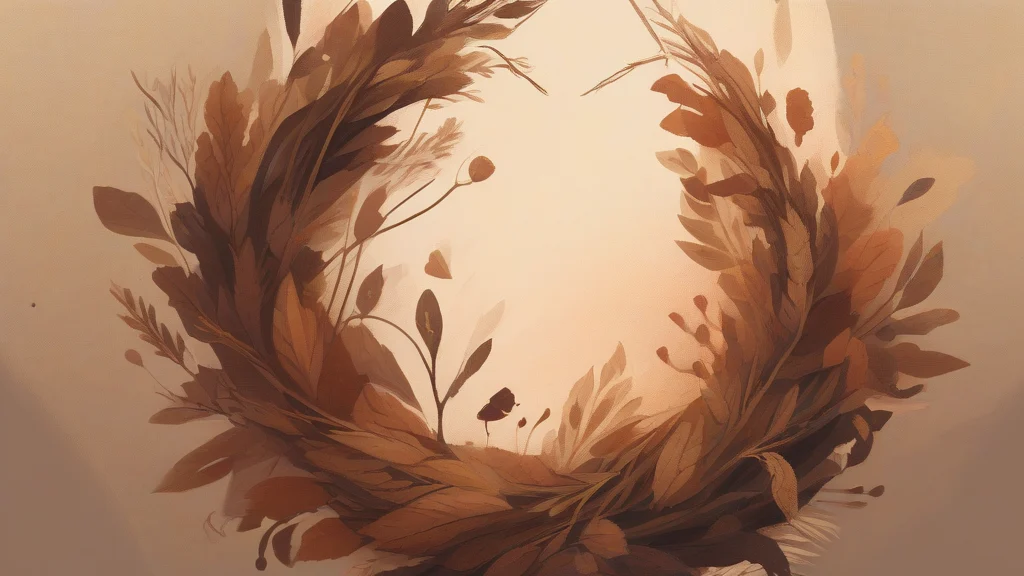
What does wreathing mean?
Wreathing is the present participle of wreath, a verb meaning to wind something around, intertwine it, or encircle it in a wreathlike form. Its imagery is strongly visual: it can describe flowers or leaves arranged around a doorway, a figure, or an object, but it is equally effective for smoke, mist, fog, or clouds curling around their surroundings. The second use is especially evocative because it suggests movement, softness, and gradual enclosure rather than a rigid circle. In literary and poetic writing, “wreathing” often carries an atmospheric or ceremonial tone, combining beauty with mystery. The form is normally used either in continuous constructions, such as “she was wreathing the door with roses,” or attributively before a noun, such as “wreathing smoke.” Although the word can suggest decoration and festivity in one context, it can also describe something mysterious or threatening in another, such as smoke surrounding a damaged building. Its ability to connect garlands, vegetation, mist, and smoke makes it a particularly flexible word for descriptive writing.
verbTo encircle or intertwine something with a wreath, garland, or wreathlike arrangement. It can also describe smoke, mist, or similar matter curling around something in a twisting mass.
- To form a twisting or encircling mass around something.
- To surround or decorate something with a wreath, garland, or intertwined arrangement.
"Wildflowers wreathed the old stone doorway while mist wreathed the cottages below."
"Smoke wreathed around the ruins after the last flames had died."
"The statue was wreathed with ivy and tiny white flowers."
Wreathing occupies two vivid worlds: the ceremonial beauty of a garland and the shifting mystery of smoke curling through the air.
Reviewed by Deb Chak, Editor. AI-assisted content curated by RJS Tech Solutions LLP.
Where does wreathing come from?
Wreathing is the present-participle and gerund form of wreath, meaning to wind around or decorate with a wreath. Wreath developed from Old English wrīth, meaning a garland or circular arrangement, and the verb wreath was subsequently derived from that noun. The English words are related to writhe and related older forms, although their modern meanings and grammatical roles have diverged.
Related word forms
How wreathing is actually used
The word is chiefly literary or poetic. Its -ing form may function attributively before a noun, as in “wreathing smoke,” while the full form is standard in continuous verb constructions.
Easily confused with wreathing
“Wreathing” is the present-participle form, as in “wreathing smoke,” whereas “wreathed” is the past tense or past participle, as in “she wreathed the door with flowers.”