
What does yew mean?
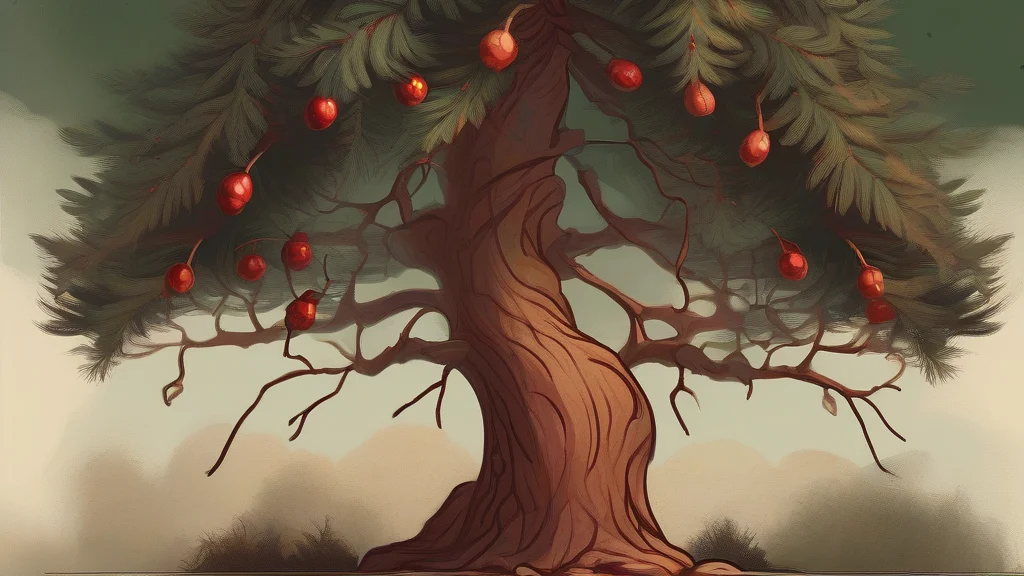
Yew is an evergreen conifer whose English name refers both to the tree and, by extension, to its distinctive wood. The tree has dark green, needle-like leaves and produces red, berry-like structures whose seeds are poisonous, so the plant is valued more for its appearance and cultural associations than for eating. Yews have long been planted in British and American churchyards and cemeteries, where their dense foliage creates a solemn, sheltered atmosphere. Their wood is exceptionally hard and close-grained, making it useful for furniture, carving, veneer, and especially the longbows historically associated with English archers. The word is pronounced like the pronoun you and can also be confused in speech with ewe, a female sheep. In ordinary use, yew most often denotes the tree, while phrases such as yew wood and yew bow identify its material or a traditional object made from it.
nounYew is an evergreen coniferous tree with needle-like leaves, red berry-like arils, and dense, close-grained wood. The word can also refer to the wood of the tree, especially when used for bows, furniture, or veneer.
- An evergreen coniferous tree, especially the European yew, with needle-like leaves and red arils surrounding poisonous seeds.
- The dense, close-grained wood of the yew tree, used for bowmaking, furniture, carving, and veneer.
"The ancient churchyard was shaded by a row of yews."
"The old churchyard was lined with yews, their dark evergreen foliage providing shelter for birds."
"The cabinetmaker selected yew for the table because its fine grain takes a smooth, rich finish."
The plural is standard when referring to multiple yew trees; the plural yews is less common when discussing the wood as a material.
"Several yews grow around the old abbey."
The yew tree is both a graveyard landmark and a bow-maker's dream: its resilient wood helped shape the famous English longbow.
Reviewed by Deb Chak, Editor. AI-assisted content curated by RJS Tech Solutions LLP.
Where does yew come from?
The English word descends from Old English ēoh, meaning the yew tree, and ultimately from Proto-Germanic *ehwaz. It has close cognates in Welsh ywen, German Eibe, and Swedish ide, while Latin taxus and Greek taxos represent related forms in other branches of the Indo-European word family. The spelling and pronunciation developed through Middle English, with the modern form yew continuing the native Germanic word rather than being borrowed directly from Latin.
How yew is actually used
The word is neutral in both British and American English. In British English, yew is especially familiar as a tree commonly planted in churchyards; in American English, it is also used in botanical, woodworking, and bowmaking contexts.
Easily confused with yew
Yew is a noun referring to an evergreen tree or its wood, while you is a pronoun referring to the person being addressed.
Yew refers to a tree or its wood, whereas an ewe is a female sheep.