
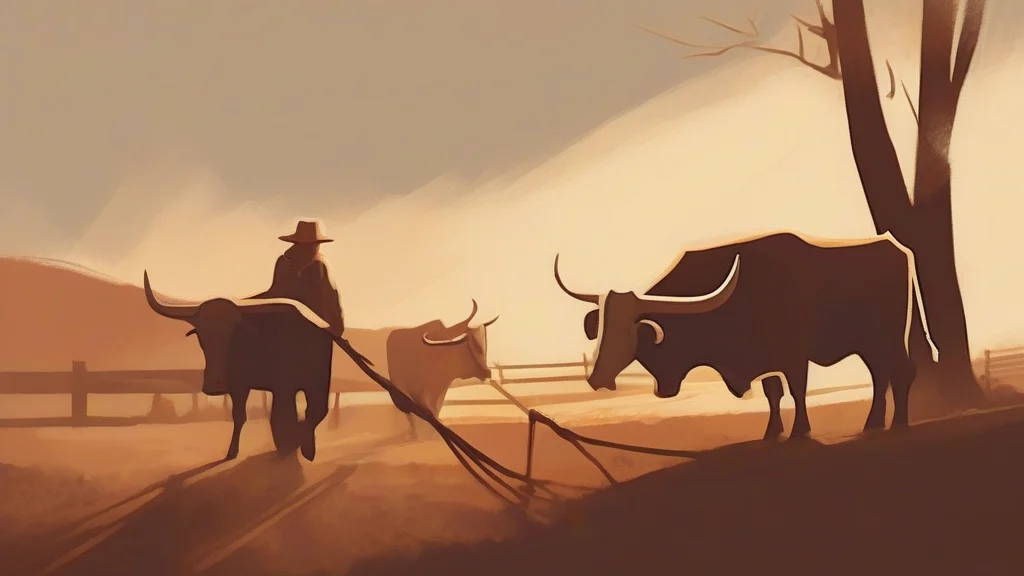
What does yoke mean?
Yoke is a word that joins the practical world of animal labor with the political and emotional language of control. As a noun, it originally names the wooden beam or frame placed across draft animals so they can pull a load together. It can also mean the pair of animals wearing that device, a supporting frame, a shared burden, or a condition of subjection. In figurative use, “the yoke” often describes oppressive authority, burdensome duty, or a relationship that limits freedom. As a verb, “to yoke” means to fit an animal with a yoke or fasten something with one. By extension, it means to couple people or things together, often deliberately and inseparably, as in “yoking two systems together,” or to bring someone under domination. The word is especially useful because it turns a familiar farm object into a powerful image of cooperation, dependence, obligation, and power.
A wooden beam, crosspiece, or frame used to harness draft animals or support a load; also a pair of animals joined together. Figuratively, it means a burden, restrictive authority, or state of subjection.
"The oxen strained against the yoke as the cart began to move."
The word has several established figurative uses, including a shared responsibility or burden and a restrictive system of authority.
To fit or fasten something with a yoke; to join or couple two people, animals, or things; or to bring someone under control or subjection.
"The treaty yoked the two provinces into a single administration."
The figurative verb often conveys deliberate attachment or, in the sense of domination, coercion.
The plural is used for multiple individual yokes or yoke frames. A matched pair of draft animals can be called a yoke in the singular.
"The repair shop made two new yokes for the oxen."
Yoke carries two linked ideas: the wooden beam that makes animals work together and the figurative burden that can make people or nations feel controlled.
Reviewed by Deb Chak, Editor. AI-assisted content curated by RJS Tech Solutions LLP.
Where does yoke come from?
Yoke descends from Old English geoc, a Germanic word related to forms such as Old Norse jōk and Old High German juch. The modern spelling was influenced by Old French joug, which came from Latin iugum, the Latin word for a yoke. Latin iugum also underlies words such as conjugate and subjugate, reflecting the original ideas of joining together or placing under a yoke.
Related word forms
How yoke is actually used
The literal agricultural senses are neutral and traditional. Figurative uses, especially in phrases such as “under the yoke” and in the verb “to yoke,” often suggest restraint, compulsion, or control and can have a formal or literary tone.
Easily confused with yoke
A yoke is a restraint or joining device for animals, whereas a yolk is the yellow part of an egg.