
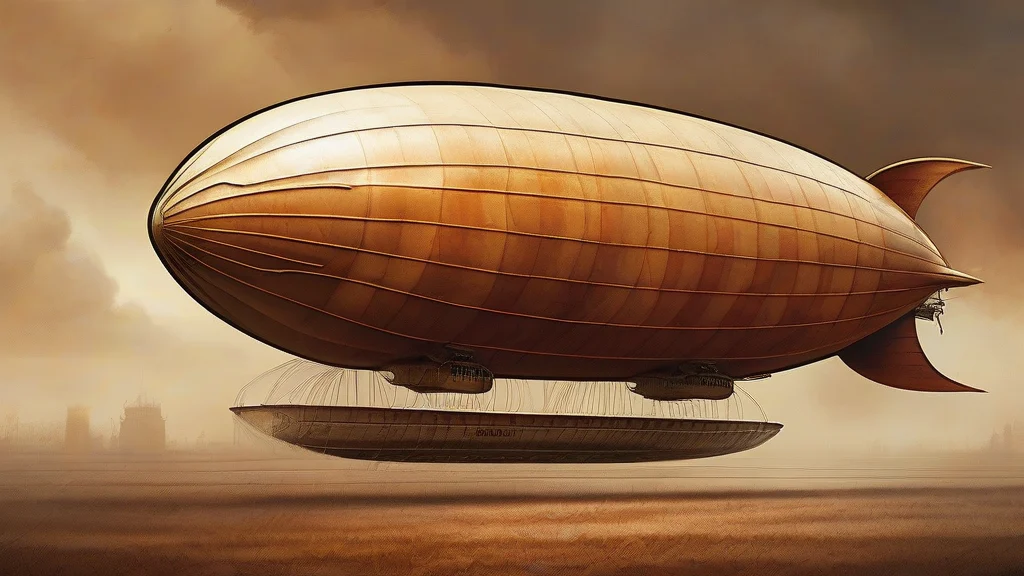
What does zeppelin mean?
A zeppelin is a large airship distinguished by a rigid internal framework, lifting gas, and engines that allow it to travel through the air. The word comes from the name of Count Ferdinand von Zeppelin, whose pioneering designs helped establish the practical rigid airship. In modern English, zeppelin can refer both to historical aircraft of this type and, more generally, to a striking or fictional flying vessel resembling one. The word often carries nostalgic associations with early aviation, exploration, elegance, and spectacle, though it is also inseparable from the Hindenburg disaster and its lasting influence on public attitudes toward airships. Although blimp is sometimes used as a loose synonym, the two terms are technically distinct: zeppelins are rigid, while blimps are generally non-rigid. The unusual shape and dramatic visibility of a zeppelin make it especially memorable in journalism, fiction, advertising, and popular culture.
nounA large airship with a rigid internal framework, filled with gas lighter than air and propelled by engines. The name was originally associated with the rigid airships developed by Count Ferdinand von Zeppelin.
- A large, rigid airship filled with gas lighter than air and propelled by engines.
"The vintage zeppelin drifted serenely across the harbor while passengers watched the city from above."
"The museum has restored a zeppelin that once carried passengers across the Atlantic."
"The campaign’s enormous inflatable zeppelin was mistaken for an actual aircraft by bystanders."
The regular plural is used when referring to more than one airship.
"Two surviving zeppelins are preserved as museum exhibits."
The word carries the romance of aviation’s golden age—and the stark memory of the Hindenburg disaster, which made the zeppelin one of history’s most famous aircraft.
Reviewed by Deb Chak, Editor. AI-assisted content curated by RJS Tech Solutions LLP.
Etymology of zeppelin
The word entered English from German, where Zeppelin is the surname of Count Ferdinand von Zeppelin, the aviation pioneer associated with the development of rigid airships. The English name initially referred to airships built to his designs and was later used more broadly for similar aircraft. It has no widely established family of ordinary English cognates beyond this German source.
How zeppelin is actually used
Technically, zeppelin refers to a rigid airship, while blimp usually refers to a non-rigid one. In general use, however, zeppelin may evoke any large, conspicuous airship and can carry nostalgic, adventurous, or even faintly comic associations.
Easily confused with zeppelin
A zeppelin is a rigid airship with a structural framework, whereas a blimp is generally a non-rigid airship that maintains its shape through the pressure of the lifting gas.