
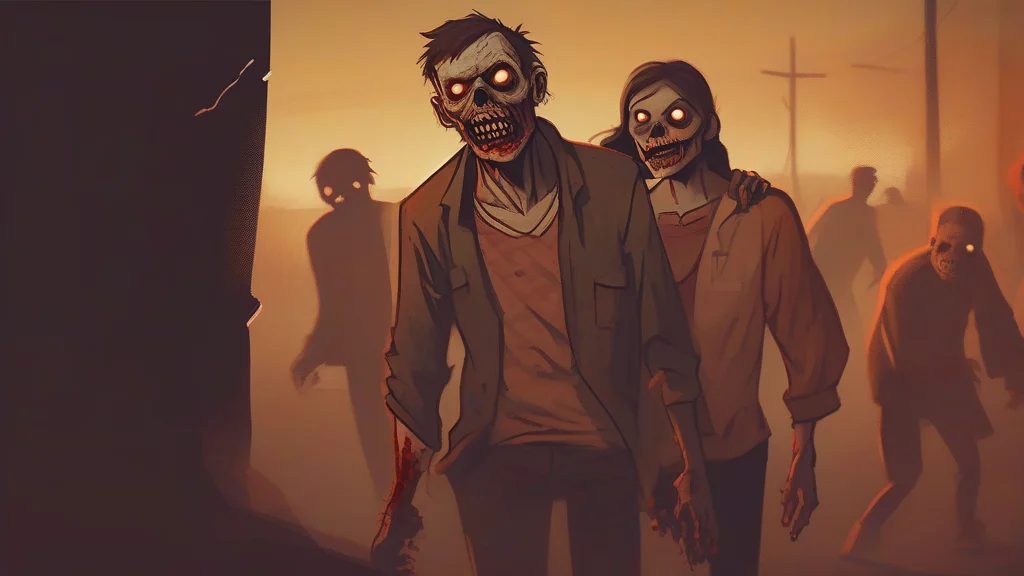
What does zombielike mean?
Zombielike is an adjective meaning that a person or thing resembles a zombie. Its central implication is not that the subject is literally undead, but that it appears lifeless, dazed, emotionally numb, slow, or strangely disconnected from its surroundings. People may be described as zombielike after extreme fatigue, shock, intoxication, grief, or prolonged stress, while a landscape, crowd, or performance might be called zombielike when it appears dull and mechanically repetitive. The word is especially effective for figurative descriptions because it condenses the visual and emotional associations of zombie fiction into a vivid comparison. In literary or atmospheric writing, it can also characterize movement that seems slow, aimless, or automatic. Zombielike is not usually the neutral or precise term for someone who is merely lazy or unmotivated, since it carries stronger associations with shock, dissociation, and eerie behavior. It is therefore most appropriate in informal prose, creative writing, and descriptive journalism rather than formal technical discussion.
adjectiveResembling a zombie in appearance or behavior, especially in looking dazed, lifeless, or unresponsive.
- Resembling a zombie, especially in having a lifeless, dazed, or unresponsive appearance.
- Moving, speaking, or acting in a slow, mechanical, or seemingly unconscious manner.
"The stranded passengers continued forward with a zombielike expression."
"The stranded passengers stared ahead with a zombielike expression."
"Sleep deprivation left him zombielike, moving through the room as if on autopilot."
Zombielike captures that uncanny human state in which a person is physically present but seems almost switched off.
Reviewed by Deb Chak, Editor. AI-assisted content curated by RJS Tech Solutions LLP.
Etymology of zombielike
Zombielike is an English compound formed from the noun zombie and the productive suffix -like, meaning “resembling.” Zombie entered English from New World Creole in the eighteenth century in association with Haitian voodoo and supposedly reanimated corpses; its deeper source is debated, though it is commonly linked to a Kongo term referring to a deity or master. The suffix -like descends from Old English līc, meaning “body, form, or likeness,” and had become productive for words of resemblance in Middle English. Modern relatives such as zombify, zombified, and zombification retain the same zombie base.
How zombielike is actually used
This is primarily an informal, figurative word. It commonly suggests emotional numbness, exhaustion, dullness, or aimless behavior rather than literal undeadness. Although zombielike is dictionary-attested, the hyphenated spelling zombie-like is also widely used.
Easily confused with zombielike
A zombie is a fictional reanimated corpse or undead being, whereas zombielike is an adjective describing someone or something that merely resembles one in appearance or behavior.