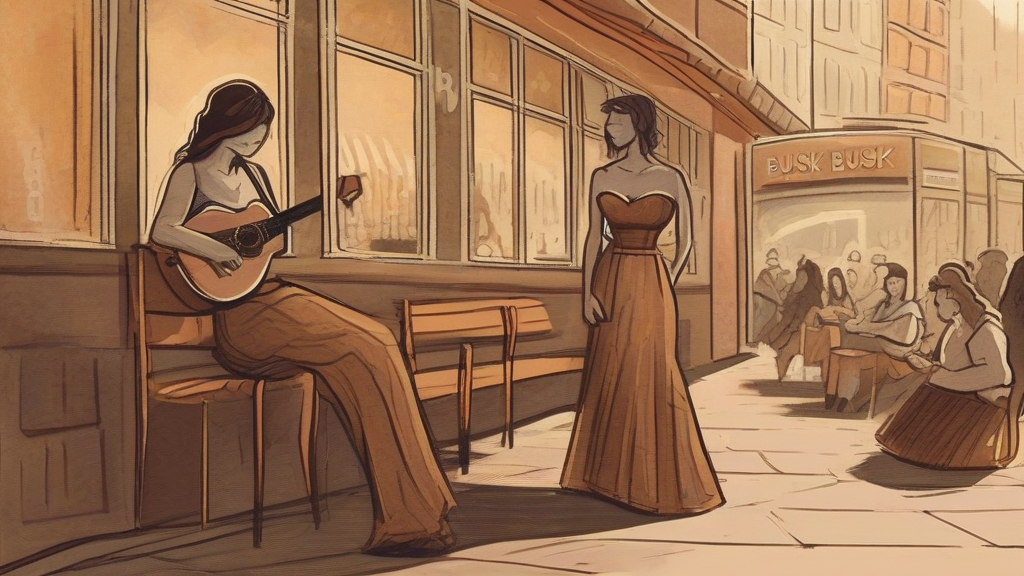
What does busk mean?
The word 'busk' has two distinct meanings. As a verb, it refers to the act of performing music in a public place, usually for tips or donations. This usage is commonly associated with street performers and musicians. As a noun, 'busk' denotes a strip of fabric, often stiffened, that runs from the breast to the waist in a corset or stays, providing support and structure. The verb form is more commonly used in informal contexts, while the noun form is more formal and related to historical clothing and textiles. Understanding the context in which 'busk' is used is crucial to interpreting its meaning correctly.
To perform music in a public place, especially for tips.
"The musician began to busk on the street corner."
Often used informally.
A strip of fabric, usually stiffened, that runs from the breast to the waist in a corset or stays.
"The corset had a sturdy busk that provided support."
More formal and related to historical clothing.
The plural form 'busks' can refer to multiple performances or multiple strips of fabric.
"The musicians performed several busks in the park over the weekend."
Reviewed by Deb Chak, Editor. AI-assisted content curated by RJS Tech Solutions LLP.
Etymology of busk
The verb 'busk' originated in the late 19th century, likely derived from the Spanish 'buscar', meaning 'to seek'. The noun 'busk', referring to the strip of fabric in a corset, has its roots in the 16th century, from the Old French 'bouter', meaning 'to push' or 'to stiffen'.
Usage notes
The verb form is often used informally and in the context of street performance. The noun form is more formal and related to historical clothing.