What does drove mean?
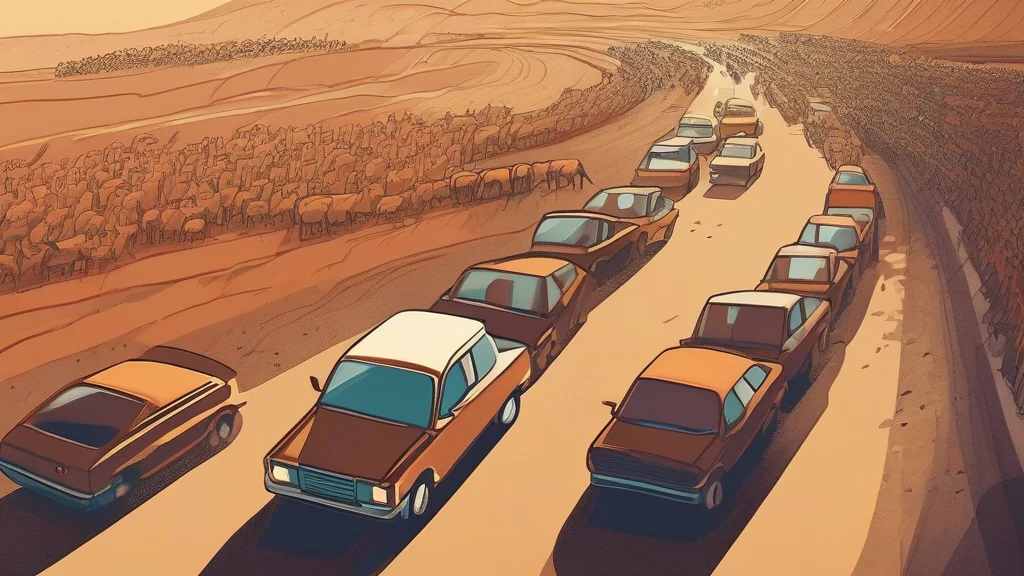
A drove is, at its root, a collection of animals — typically cattle or sheep — that are gathered together and moved as a group, often over considerable distance to market or pasture. The word extends naturally to people: a drove of shoppers or refugees suggests a dense mass moving with shared purpose. In modern English its most familiar habitat is the phrase 'in droves', used when crowds arrive, leave, or defect in very large numbers, as in 'customers left in droves after the price hike'. Separately, 'drove' serves as the simple past tense of the verb 'drive', so the same spelling can mean either a moving multitude or a completed act of driving. The noun carries a slightly old-fashioned, rural flavor in literal use, evoking the historic cattle drovers who walked herds across Britain, yet it stays fully current in figurative use. Its dual identity makes it a compact, vivid word for describing both movement and momentum.
A herd or flock of animals being driven together; by extension, a large moving crowd of people.
"A drove of cattle stretched along the road for nearly half a mile."
In reference to people, almost always appears in the plural phrase 'in droves'.
Simple past tense of 'drive': operated and controlled a vehicle, forced animals or people to move, or impelled something strongly.
"She drove through the night to reach the coast by dawn."
The plural 'droves' is chiefly fixed in the idiom 'in droves', meaning in large numbers; the singular remains common for literal herds.
"Once tickets went on sale, fans queued up in droves."
When people show up 'in droves', they're literally being compared to cattle on the move — the phrase preserves a thousand-year-old farming image.
Reviewed by Deb Chak, Editor. AI-assisted content curated by RJS Tech Solutions LLP.
Etymology of drove
'Drove' derives from Old English 'drāf', meaning a drove or company of beasts, formed from the same Germanic root that gives us the verb 'drive'. That root, carried through Proto-Germanic, also produced 'drift' and related words across the Germanic languages, all centered on the idea of forcing or propelling movement. The noun has been part of English since its earliest recorded stages, and its derivative 'drover' became especially prominent during the centuries when livestock were walked long distances to market.
Related word forms
How drove is actually used
The noun 'drove' survives most commonly today in the set phrase 'in droves', applied to people arriving or leaving in great numbers. In its literal sense of a herd being driven, it now sounds somewhat archaic or literary, though it remains standard vocabulary in historical writing about cattle droving, particularly in Scotland and Wales.
Easily confused with drove
'Dove' is the past tense of 'dive' (or the bird), whereas 'drove' is the past tense of 'drive' or a noun meaning a moving herd or crowd.