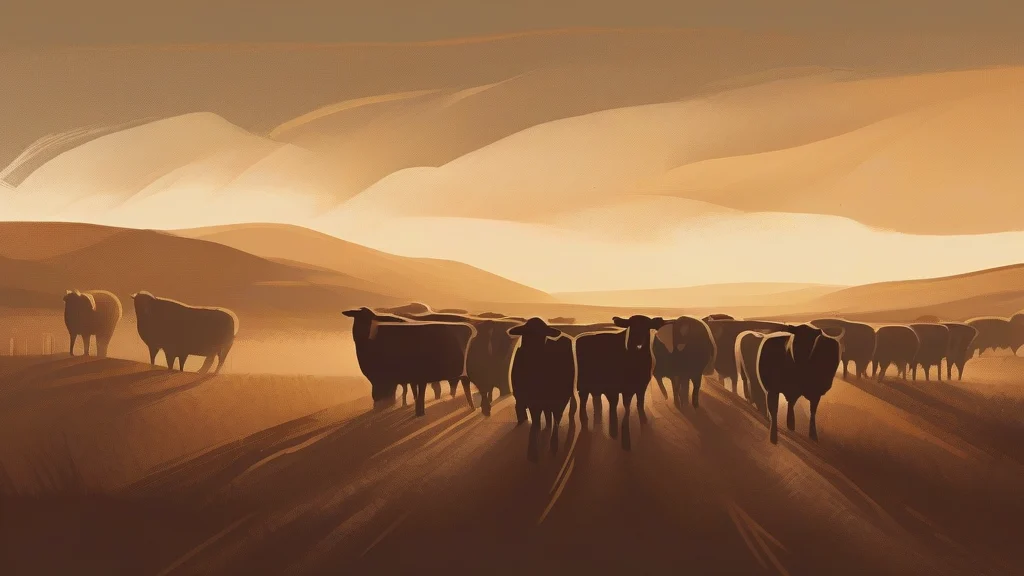
What does droving mean?
Droving is the practice of moving livestock — most commonly cattle and sheep — over long distances on foot, traditionally from grazing grounds to distant markets. The men who did this work were called drovers, and they travelled along well-worn paths known as drovers' roads, some of which survive as footpaths and lanes in Britain today. Droving flourished from medieval times until the arrival of railways in the nineteenth century made long-distance walking of stock uneconomic, though it persisted in remote regions such as the Australian outland well into the modern era. The word carries strong connotations of rural tradition, hardship, and seasonal labour, evoking images of dusty roads, slow-moving herds, and nights spent camping beside the animals. Today it appears mostly in historical writing and heritage contexts, making it a distinctive term for anyone interested in pastoral history or the vocabulary of the countryside.
nounThe activity of driving livestock, especially cattle or sheep, over long distances on foot to market or to new pasture. Historically it refers to the practice of moving herds along established routes known as drovers' roads.
- The occupation or practice of driving livestock (cattle, sheep) over long distances on foot, historically along drovers' roads to markets.
"In the eighteenth century, droving brought thousands of Welsh cattle south to English markets each autumn."
"Droving was hard, seasonal work that kept drovers on the road for weeks at a time."
"The old droving routes across the Welsh hills can still be traced today."
Before railways existed, entire economies ran on droving — Scottish Highlanders once walked their cattle hundreds of miles to English markets, a journey that could take weeks.
Reviewed by Deb Chak, Editor. AI-assisted content curated by RJS Tech Solutions LLP.
Etymology of droving
Droving derives from the noun 'drove', meaning a herd of driven animals, which comes from Middle English 'drove', itself rooted in Old English 'drāf', related to the verb 'drīfan' ('to drive'). The suffix '-ing' forms a noun denoting the activity of driving such herds. The term is therefore native Germanic rather than Latin-derived, and its cognates include ordinary 'drive' and related Germanic words for driving or pushing.
Related word forms
How droving is actually used
The word is now chiefly historical or regional, strongly associated with British, Irish, and Australian rural history. In Australia, 'droving' remained in active use into the twentieth century for moving cattle and sheep across vast outback distances. It is a mass noun with no plural.
Easily confused with droving
Drowning refers to suffocation in water, while droving refers to driving livestock overland; they differ by a single letter but are entirely unrelated in meaning.