What does drover mean?
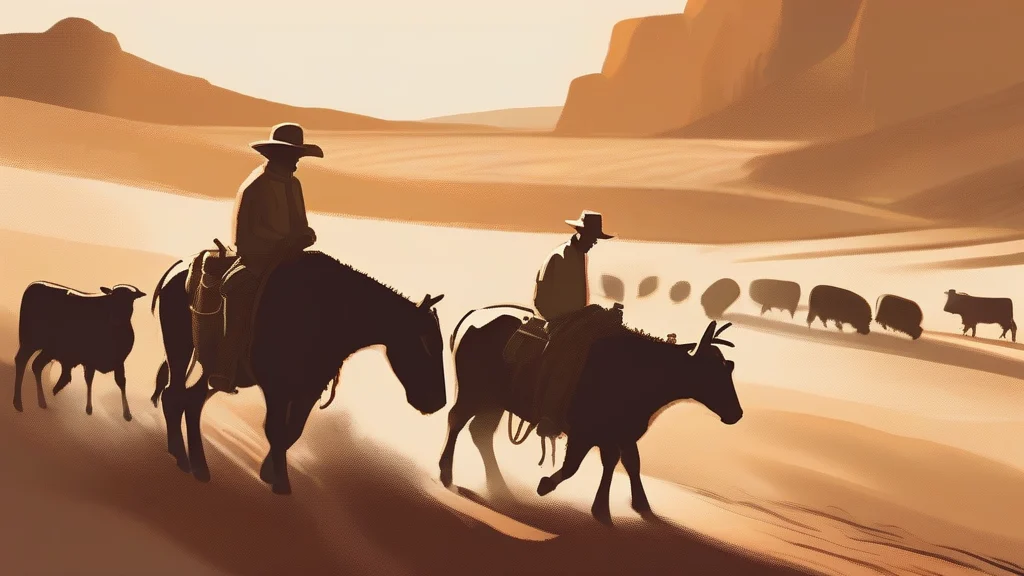
A drover is a person whose work is moving livestock — most often cattle or sheep — over long distances, traditionally on foot or horseback, to markets or seasonal pastures. The word carries strong historical connotations: in Britain, drovers once walked animals along well-worn routes known as drovers' roads, while in Australia and the American West they played a central role in the great cattle drives of the nineteenth century. Today "drover" is used mainly in historical, literary, or regional contexts, since modern livestock transport relies on trucks. The term evokes images of open country, long journeys, and the hardy independence of rural life. It remains a valuable word for anyone reading about agricultural history, frontier literature, or the folklore of pastoral communities, where the drover stands alongside the shepherd and cowboy as an enduring figure of the countryside.
nounA person whose occupation is driving livestock, especially cattle or sheep, over long distances to market or pasture.
- A person employed to drive cattle or sheep over long distances, typically to market.
"The drover guided his herd along the dusty trail toward the railhead at Abilene."
"The young drover set out before dawn with three hundred sheep bound for the autumn fair."
"Australian stockmen still celebrate the drovers who once moved cattle across vast outback distances."
Regular plural; also appears in fixed phrases such as "drovers' roads" referring to historic livestock routes.
"The drovers gathered at the inn after weeks on the trail."
Long before railways crisscrossed the countryside, drovers walked herds hundreds of miles — some ancient 'drovers' roads' in Britain are still traceable today.
Reviewed by Deb Chak, Editor. AI-assisted content curated by RJS Tech Solutions LLP.
Etymology of drover
"Drover" derives from the noun "drove," meaning a herd of driven animals, which comes from the Old English verb "drīfan" (to drive). It was formed by adding the agentive suffix "-er" to "drove," producing a term for one who drives herds. The word has cognates across the Germanic languages, including German "treiben" and Dutch "drijven," all stemming from the same Proto-Germanic root *drībaną. It has been used in English since at least the late medieval period.
How drover is actually used
"Drover" is somewhat old-fashioned and evokes historical or rural contexts; in modern usage it often appears in discussions of pastoral history rather than as a current job title.
Easily confused with drover
A driver operates a vehicle, while a drover moves livestock on foot (or on horseback) overland.