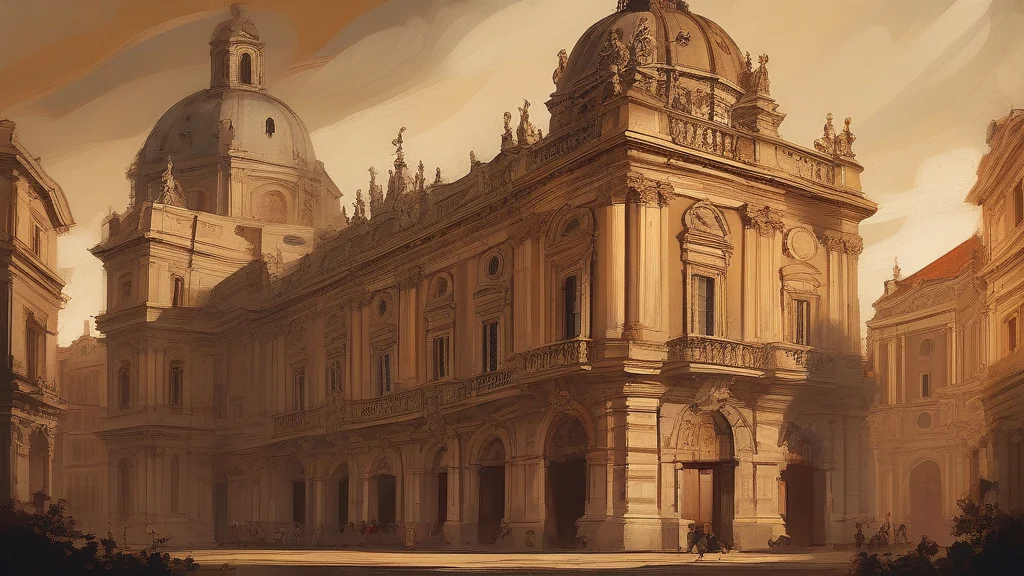
What does baroque mean?
Baroque describes the dominant European style of art, architecture, sculpture, and music that flourished from roughly the early seventeenth century to the mid-eighteenth century. Characterized by dramatic movement, intense emotion, rich colour, gilded surfaces, and exuberant ornamentation, it produced masterpieces such as the ceilings of Roman churches and the operas of Bach and Handel. In modern usage, the word also carries an extended, figurative sense: anything — a plot, an argument, a machine, a piece of prose — that is extravagantly intricate or overwrought may be called baroque, usually with a hint of criticism. This dual character makes the word useful both as a precise art-historical label and as a vivid shorthand for excess. Its origins are debated, but one popular theory traces it to the Portuguese word for a misshapen pearl, suggesting that the term began as an insult before the style it mocked came to be admired as one of the most dynamic movements in Western culture.
Characteristic of the Baroque style of art, architecture, and music (c. 1600–1750), marked by elaborate ornamentation, bold contrasts, and dramatic effect; more generally, extravagantly ornate or convoluted.
"The cathedral's baroque interior dazzles visitors with its gilded altars and swirling marble columns."
A work, artist, or instance belonging to the Baroque style.
"The exhibition paired Italian baroques with Dutch Golden Age paintings."
Rarely used as a countable noun; the plural applies only when referring to multiple individual works or examples of the style.
"The gallery acquired two Italian baroques last year."
The word 'baroque' likely comes from Portuguese 'barroco' meaning an irregularly shaped pearl — so the entire era of ornate European art is named after a misshapen gem.
Reviewed by Deb Chak, Editor. AI-assisted content curated by RJS Tech Solutions LLP.
Etymology of baroque
The word baroque entered French in the mid-sixteenth century and English by the late seventeenth, most likely derived from the Portuguese 'barroco' meaning an irregular or imperfectly shaped pearl, though some scholars link it instead to Italian 'barocco'. Originally applied disparagingly to eccentric or overly elaborate art, it was gradually rehabilitated during the nineteenth and twentieth centuries into a neutral, even admiring label for the grand European style of roughly 1600–1750.
How baroque is actually used
In art-history contexts 'Baroque' is used neutrally and often capitalized to denote a specific historical period. In everyday use, calling something 'baroque' often implies excessive complexity or ornamentation, carrying a slightly pejorative tone. The word functions primarily as an adjective but can be used as a noun when referring to works or practitioners of the style.
Easily confused with baroque
Rococo is a later 18th-century French style that is lighter, more playful and decorative, whereas Baroque is the earlier, grander, more dramatic 17th-century style.