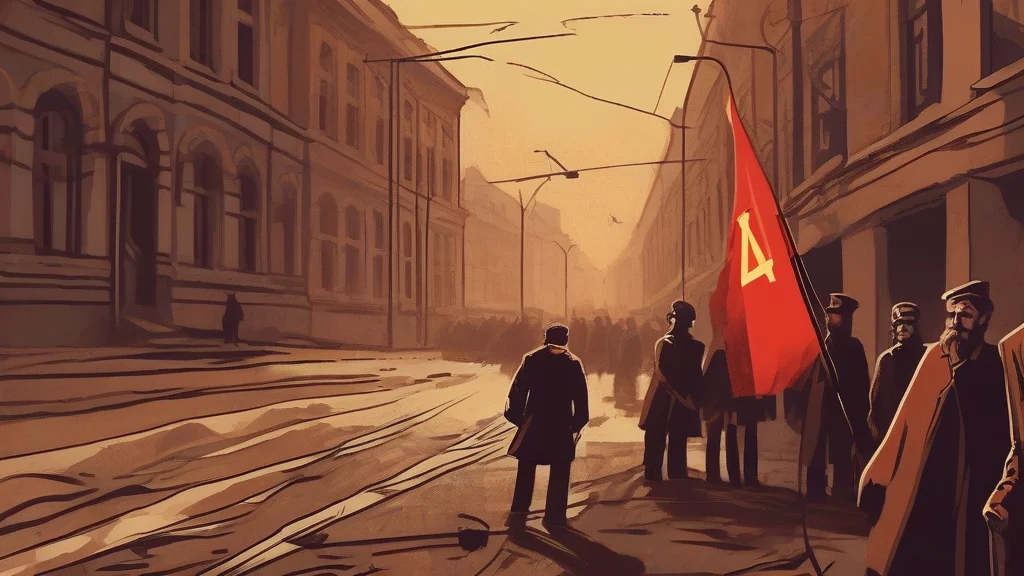
What does bolshevik mean?
A Bolshevik was a member of the majority wing of the Russian Social Democratic Labour Party, the movement founded by Vladimir Lenin that seized power during the October Revolution of 1917 and subsequently became the Communist Party of the Soviet Union. The word derives from the Russian 'bolshinstvo', meaning 'majority', reflecting an early tactical victory in a party dispute — even though the Bolsheviks were not consistently the larger faction. Beyond its precise historical meaning, the term has been extended to describe anyone holding strongly revolutionary or far-left political views, sometimes as a loose or pejorative label rather than a specific affiliation. Today the word is chiefly encountered in historical writing about Russia and the Soviet Union, though it occasionally surfaces in political rhetoric. Related terms include Menshevik, the name of the rival minority faction, and Bolshevism, the ideology associated with Lenin's followers.
nounA member of the majority faction of the Russian Social Democratic Party, led by Lenin, which seized power in the October Revolution of 1917 and became the Communist Party of the Soviet Union. By extension, a person with radical left-wing or revolutionary political views.
- A member of Lenin's majority faction of the Russian Social Democratic Party, which seized power in the October Revolution of 1917 and formed the Communist Party of the Soviet Union.
- More generally, a person with extreme or revolutionary left-wing views (often used loosely or pejoratively).
"The Bolsheviks seized power in Petrograd in October 1917 and reshaped the course of the twentieth century."
"The Bolsheviks under Lenin signed the Treaty of Brest-Litovsk in 1918 to take Russia out of the First World War."
"His colleagues dismissed him as a Bolshevik for proposing to redistribute the department's budget equally."
Standard English plural; used both for members of the historical party and, by extension, for groups of radical leftists.
"The Bolsheviks established a one-party state after dissolving the Constituent Assembly in January 1918."
In 1917 a faction whose name literally meant 'member of the majority' was actually the smaller of Russia's two Marxist groups — and it went on to rule a sixth of the world's landmass.
Reviewed by Deb Chak, Editor. AI-assisted content curated by RJS Tech Solutions LLP.
Etymology of bolshevik
The word comes from Russian 'bol'shevik' (болшевик), derived from 'bol'she' meaning 'more' or 'greater' and ultimately from 'bol'shoy', meaning 'big' — so a Bolshevik was literally a 'member of the majority'. The name arose from the 1903 split in the Russian Social Democratic Labour Party, when Lenin's faction won a vote at the Second Congress and claimed the title of majority ('bolshinstvo'), while their rivals became known as Mensheviks, from 'men'shinstvo', meaning 'minority'. The English word entered usage in the early twentieth century as news of the Russian revolutionary movement spread.
Related word forms
How bolshevik is actually used
Capitalization matters: 'Bolshevik' refers specifically to the historical Russian revolutionary party member, while lowercase 'bolshevik' is sometimes used more loosely for any radical leftist. In modern usage the term is largely historical, though it can carry pejorative overtones when applied figuratively. The adjectival form is 'Bolshevik' or 'Bolshevist', and the abstract noun for the ideology is 'Bolshevism'.
Easily confused with bolshevik
The Mensheviks were the rival minority faction of the same Russian Social Democratic Party; the Bolsheviks were Lenin's majority faction that ultimately took power in 1917.