What does buddha mean?
Buddha is a title rather than a personal name, derived from a Sanskrit word meaning 'awakened' or 'enlightened.' It most commonly refers to Siddhartha Gautama, the sixth-century-BCE Indian prince whose teachings founded Buddhism, though Buddhist traditions recognize other Buddhas across cosmic history. In everyday English the word appears in phrases like 'the Buddha's teachings' and in references to the serene statues found in temples, gardens, and homes across Asia and beyond. Because it names a revered religious figure rather than an ordinary concept, the word carries connotations of wisdom, compassion, and inner peace, and it is almost always capitalized in standard usage. Beyond its religious core sense, 'Buddha' has entered broader cultural vocabulary through meditation practices, art history, and popular ideas about mindfulness, making it a word that bridges sacred tradition and secular modern life.
nounA title given to Siddhartha Gautama, the founder of Buddhism, meaning 'awakened one' or 'enlightened one'; more broadly, any person who has attained complete enlightenment in the Buddhist tradition.
- Siddhartha Gautama, the founder of Buddhism (usually with capital B and often preceded by 'the').
- Any person who has attained full enlightenment in the Buddhist tradition.
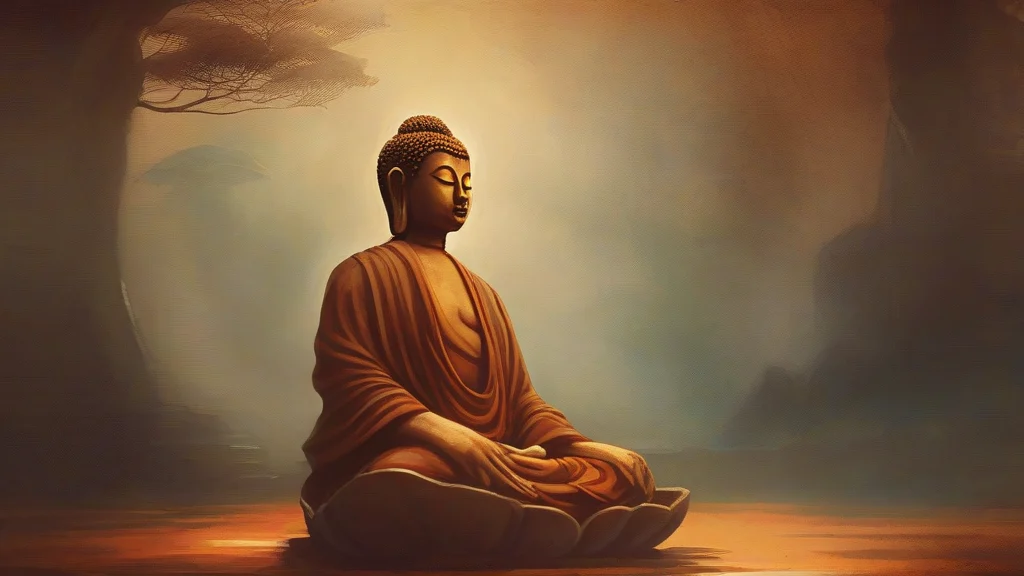
- A statue or image depicting such a figure.
"The monks gathered beneath the bodhi tree to meditate on the teachings of the Buddha."
"Pilgrims travel from around the world to see the ancient Buddha carved into the cliff face."
"In some traditions, there have been many Buddhas throughout history, not just one."
Plural form is used when referring to multiple enlightened beings or multiple statues/images.
"The temple hall houses dozens of Buddhas in various postures."
The word literally means 'one who woke up' — enlightenment, at its root, is simply waking up.
Reviewed by Deb Chak, Editor. AI-assisted content curated by RJS Tech Solutions LLP.
Etymology of buddha
The English word comes via Latin and Pali 'Buddha' from Sanskrit 'buddha,' meaning 'awakened' or 'enlightened,' formed from the past participle of 'budh,' 'to wake, become aware.' The term was adopted into European languages during the colonial era as Western scholars encountered Buddhist texts and traditions. It shares its ultimate root with related Sanskrit-derived terms such as 'bodhi' (awakening) and 'Bodhisattva' (an enlightenment-seeking being).
Related word forms
How buddha is actually used
Typically capitalized and often preceded by the definite article when referring to Gautama himself. Lowercase use ('a buddha') for any enlightened being appears mainly in Buddhist scholarly writing; in general English it remains capitalized as a proper noun or respectful title.
Easily confused with buddha
'Buddha' is the title of an enlightened person, while 'bodhi' refers to the state or tree associated with awakening itself.