What does cossack mean?
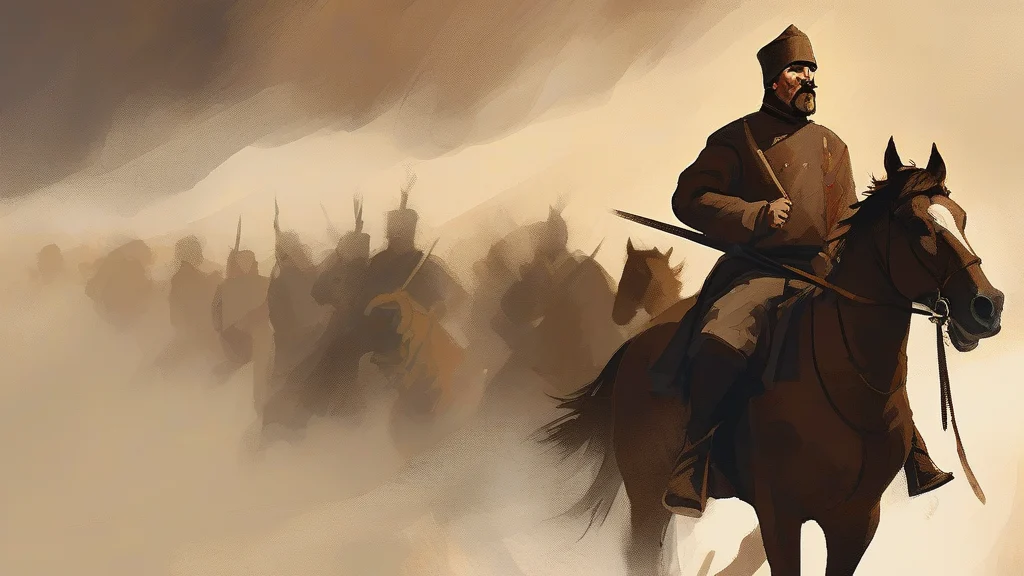
A Cossack is a member of a group of predominantly East Slavic-speaking peoples who formed semi-autonomous military communities in the steppes of southern Russia and Ukraine from roughly the fifteenth century onward. Renowned for exceptional horsemanship and fierce fighting ability, Cossacks organized themselves into self-governing bands known as hosts, living beyond the reach of neighbouring empires before many entered imperial service as frontier cavalry under the Russian tsars. The name derives from a Turkic word meaning 'free adventurer' or 'freebooter', reflecting their origins as escaped serfs and frontiersmen. In modern English the term appears most often in historical writing about Russia and Eastern Europe, and attributively for distinctive styles of clothing such as the fur-trimmed Cossack hat or loose Cossack coat. The word evokes romantic images of mounted warriors on the open steppe, though it can also carry harsher associations from Cossacks' historical role in suppressing revolts.
nounA member of a people of southern Russia and Ukraine, historically organized into self-governing military communities famed for their horsemanship and skill as warriors. Also used attributively of things relating to Cossacks, such as the loose-fitting Cossack coat or the fur-trimmed Cossack hat.
- A member of any of the historically self-governing military communities of Slavic-speaking peoples in southern Russia and Ukraine, noted for cavalry skill.
- (Attributive) Relating to or characteristic of Cossacks, as in 'Cossack hat' or 'Cossack dress'.
"The Cossacks rode across the steppe in loose formation, their banners snapping in the wind."
"Under the tsars, Cossacks served as frontier guards and irregular cavalry."
"She wore an astrakhan Cossack hat against the winter cold."
Standard pluralization applies; capitalization follows the same convention as the singular.
"Thousands of Cossacks gathered for the annual review."
The word 'cossack' comes from a Turkic term meaning 'free adventurer' — the same root that gave us 'Kazakh', though the two peoples are completely unrelated.
Reviewed by Deb Chak, Editor. AI-assisted content curated by RJS Tech Solutions LLP.
Etymology of cossack
The word enters English in the late sixteenth century from Polish 'kozak' and Russian 'kazak', which themselves derive from Turkic 'qazaq', meaning 'free man', 'adventurer', or 'freebooter'. The same Turkic root independently produced the name of the Kazakh people of Central Asia, making the two ethnonyms linguistic cognates despite referring to distinct peoples. The term originally described fugitives and frontiersmen who settled the steppe lands beyond the reach of Polish-Lithuanian and Muscovite authority.
Related word forms
How cossack is actually used
Usually capitalized when referring to the ethnic or historical group ('a Cossack'), but often lowercase when used attributively for clothing styles ('a cossack coat'). The word carries strong historical connotations of martial independence and, in some contexts, of repression, since Cossack units were used by the Russian Empire to suppress uprisings.
Easily confused with cossack
A Kazakh is a member of the Turkic ethnic group native to Kazakhstan; although both words derive from the same Turkic root 'qazaq', they refer to entirely different peoples.