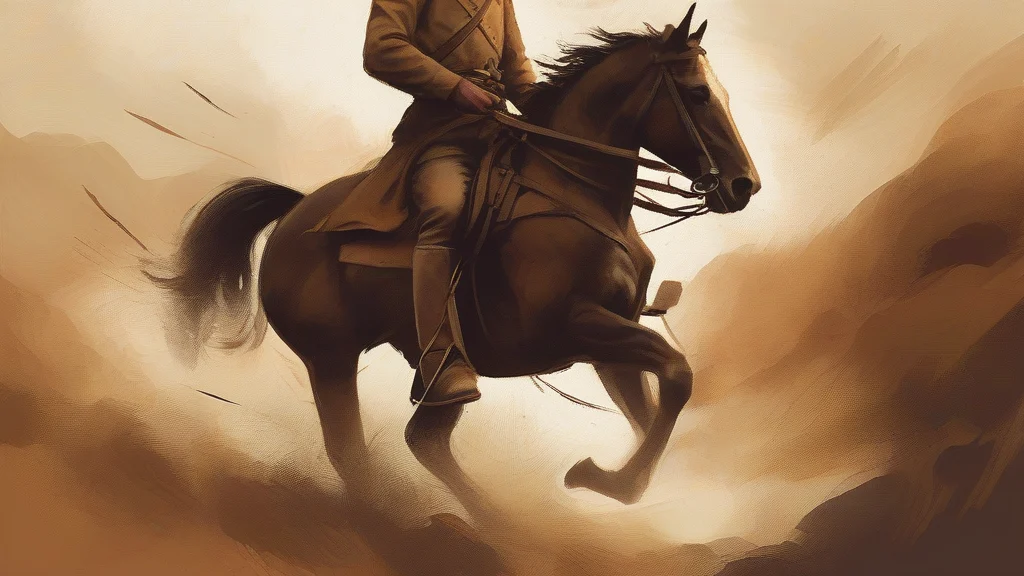
What does cavalryman mean?
A cavalryman is a soldier belonging to the cavalry — the branch of an army that fought on horseback. From antiquity through the nineteenth century, cavalrymen provided mobility, shock power, reconnaissance, and swift communication on the battlefield, and the word evokes that romantic image of sabres, plumed helmets, and thundering charges. As warfare mechanized, the term did not vanish: many armies preserved their cavalry regiments as armored units, and soldiers serving in tanks or reconnaissance vehicles are still called cavalrymen in tribute to that lineage. The noun is formed from 'cavalry', which traces back through French 'cavalerie' to Italian 'cavalleria', ultimately from Latin 'caballus' meaning horse. Today the word appears chiefly in military histories, memoirs, and regimental contexts, carrying connotations of courage, tradition, and a certain old-world panache.
nounA soldier who serves in a cavalry unit, fighting or operating on horseback (historically) or in armored vehicles (in modern usage). The term denotes any member of the mounted arm of an army.
- A soldier serving in a cavalry regiment, historically one who fought on horseback.
- By extension, a member of an armored or mechanized unit that continues the cavalry tradition in modern armies.
"The old cavalryman still spoke of his horses with more affection than he showed for most people."
"As a young cavalryman, he had ridden dispatches across the front lines during the war."
"The museum displayed the sabre and uniform of a cavalryman who served under Wellington at Waterloo."
The standard plural follows the regular '-men' pattern of compounds ending in '-man'.
"The charge was carried out by two hundred cavalrymen armed with sabres."
The most common misspelling of this word — 'calvaryman' — swaps it with the hill where Christ was crucified, one of the most frequent errors in all of English.
Reviewed by Deb Chak, Editor. AI-assisted content curated by RJS Tech Solutions LLP.
Etymology of cavalryman
'Cavalryman' combines 'cavalry' with the agentive suffix '-man'. The word 'cavalry' entered English in the sixteenth century from French 'cavalerie', borrowed from Italian 'cavalleria', derived from 'cavaliere' (horseman), which comes from Late Latin 'caballarius', based on Latin 'caballus' meaning horse. The same Latin root gives English 'cavalier' and 'chevalier', and via a different route the Germanic cognate produced 'chivalry'.
How cavalryman is actually used
The word is somewhat formal or historical in flavor today; modern militaries often use it for members of armored cavalry units even though they no longer ride horses. It carries connotations of tradition, dash, and esprit de corps.
Easily confused with cavalryman
A 'Calvaryman' relates to Calvary, the hill near Jerusalem where Jesus was crucified (or the hill in Boston's Mount Auburn Cemetery), whereas a cavalryman is a soldier of the cavalry.