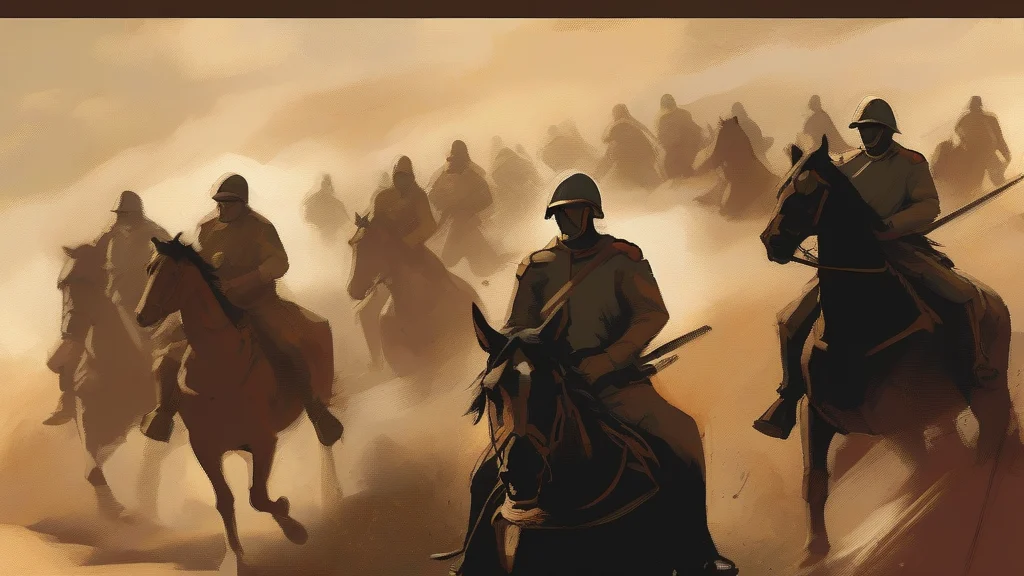
What does cavalry mean?
Cavalry refers to the branch of an army made up of soldiers who fought on horseback, a dominant arm of warfare from antiquity through the nineteenth century. Historically, cavalry excelled at rapid movement, reconnaissance, flanking maneuvers, and delivering decisive charges against infantry formations, with specialized types such as light cavalry for scouting and heavy cavalry for shock action. As warfare mechanized, horse-mounted units were gradually replaced, but many armies preserved the designation: today a "cavalry" regiment typically operates tanks, helicopters, or other vehicles, carrying forward its traditions and insignia. The word functions as a collective noun, so it commonly takes singular agreement. Beyond its literal sense, cavalry occasionally appears figuratively to mean rescuers arriving at the last moment. Its etymology connects it to the Latin caballus (horse), making it a cousin of "chivalry," "cavalier," and "chevalier" — all rooted in the idea of the horseman.
nounSoldiers who fought on horseback, historically; in modern usage, a military unit equipped to fight mounted or in armored vehicles.
- (Historical) Soldiers who fought while mounted on horseback.
- (Modern) A military unit trained to fight from armored vehicles such as tanks, retaining the historical name.
"The cavalry arrived at dawn, sweeping across the plain to break the enemy's line."
"Napoleon relied heavily on his cavalry to exploit breakthroughs in the enemy line."
"The modern regiment still bears the title of cavalry, though its troopers now ride in tanks rather than on horses."
Rarely used; the plural appears only when referring to the cavalry forces of multiple distinct armies or states.
"The cavalries of both nations clashed repeatedly along the border."
The words "cavalry" and "chivalry" share the same root — both trace back to the Latin word for horse, caballus.
Reviewed by Deb Chak, Editor. AI-assisted content curated by RJS Tech Solutions LLP.
Etymology of cavalry
Cavalry entered English in the mid-sixteenth century, borrowed from French cavalerie, which derived from Italian cavalleria, ultimately from Late Latin caballarius meaning "horseman." The root is the Vulgar Latin caballus, a word for horse that supplanted classical equus in Romance languages. The same root gives English "cavalier," "chivalry," and "chevalier," as well as Spanish "caballero," all sharing the notion of a rider or knight.
How cavalry is actually used
The word is treated as a collective noun and usually takes singular agreement in American English, though plural agreement is also acceptable. It is nearly always used in military contexts; figurative use is rare. Note the common misspelling confusion with "Calvary."
Easily confused with cavalry
"Cavalry" refers to soldiers on horseback, while "Calvary" (capital C) is the hill outside Jerusalem where Christ was crucified — they differ only by letter order.