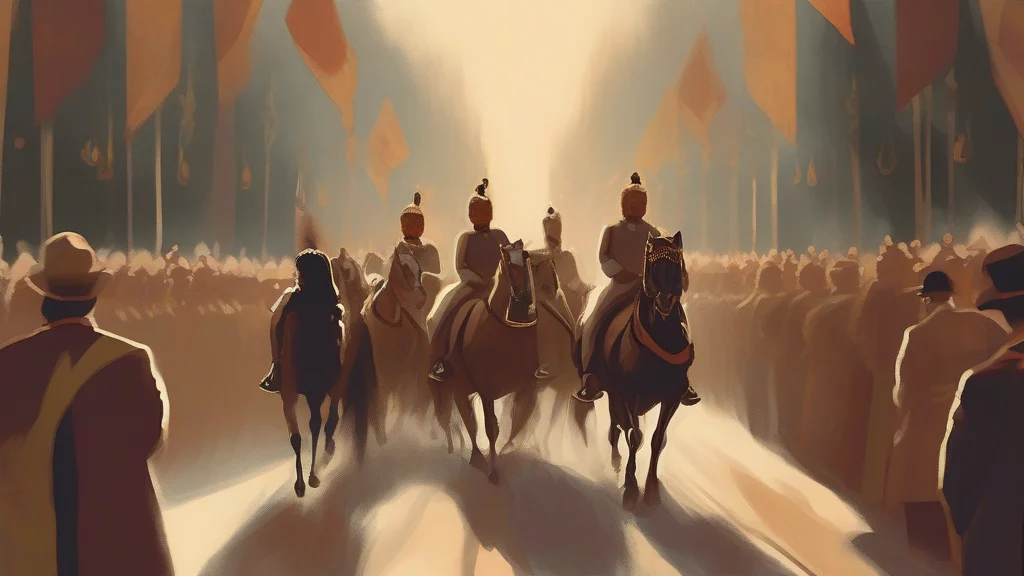
What does cavalcade mean?
A cavalcade is a formal, often ceremonial procession of people moving together — historically on horseback, today more commonly in a line of vehicles such as cars or motorcycles. The word evokes pageantry and occasion: royal weddings, state funerals, victory celebrations, and film festivals all feature cavalcades. Over time it has also developed a figurative use, describing a long, impressive, sometimes overwhelming series of events or things, as in 'a cavalcade of hits' or 'a cavalcade of disasters.' The term sits at a slightly elevated register compared with everyday alternatives like 'parade' or 'procession,' lending a tone of grandeur to whatever it describes. Its history is colorful: it entered English in the seventeenth century by way of French and Italian, ultimately tracing back to a Latin word for a horse — indeed, a humble workhorse — making it a distant cousin of 'cavalry,' 'chivalry,' and 'cavalier.' Whether literal or figurative, a cavalcade suggests movement, order, and spectacle unfolding before an audience.
A formal procession of riders, vehicles, or people moving together, especially as part of a ceremony or public celebration.
"A cavalcade of black limousines carried the dignitaries from the cathedral to the palace."
The plural is cavalcades. The word frequently appears in the construction 'a cavalcade of X' when used figuratively.
Figuratively, a long or strikingly large series of events, people, or things appearing in succession.
"The magazine's anniversary issue featured a cavalcade of interviews spanning four decades."
Standard regular plural; used both literally (multiple processions) and figuratively (multiple series of events).
"Tourists gathered along the route to watch the successive royal cavalcades pass."
Cavalcade comes from the Latin word for a nag — an old, worn-out horse — so the grandest processions are etymologically named after the humblest of steeds.
Reviewed by Deb Chak, Editor. AI-assisted content curated by RJS Tech Solutions LLP.
Etymology of cavalcade
Cavalcade entered English in the early seventeenth century, borrowed from the French cavalcade, which derives from the Italian cavalcata, meaning a ride or company of horsemen. The Italian noun comes from the verb cavalcare ('to ride'), rooted in the Late Latin caballicare, formed from caballus, a Latin word for a horse — specifically a packhorse or nag rather than a noble steed. This same root gave English several other horse-related words through Romance languages, including cavalry, chivalry, chevalier, and cavalier.
How cavalcade is actually used
Cavalcade carries a somewhat formal, ceremonial register and often connotes grandeur or spectacle. The figurative sense ('a cavalcade of complaints') is well established in journalism and criticism. It is slightly more elevated than 'parade' or 'procession'.