
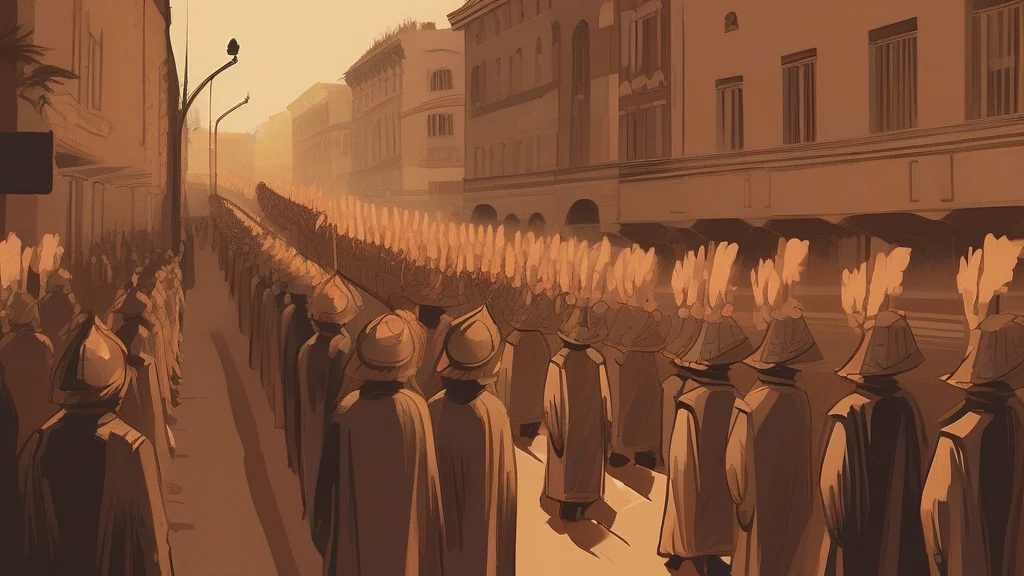
What does procession mean?
A procession is an organized group of people, vehicles, or objects moving in a line, usually for a ceremonial, religious, commemorative, or public occasion. The word often suggests order, dignity, and deliberate movement: a parade may celebrate an event, while a funeral or religious procession may express grief, faith, or communal identity. Processions can also consist of cars, riders, dancers, or other participants, with the central idea being that they advance together in an organized sequence. In a more abstract and formal use, “procession” means a continuous series or succession, as in references to the procession of the seasons or the procession of human events. Although the associated verb is relatively uncommon, the noun is widely understood and useful because it distinguishes an organized public movement from a casual crowd and from the general notion of a process.
An organized group of people, vehicles, or objects moving ceremonially in a line; also, a continuous sequence or succession.
"Thousands joined the procession as it crossed the town square."
The ceremonial sense is dominant today. The abstract sense of an ordered succession is more formal and less common.
To move or go in a procession.
"The witnesses processioned into the court."
This verb is relatively uncommon and is encountered mainly in formal or literary writing.
The standard plural is formed by adding -s; the plural form is common when referring to multiple ceremonial groups or sequences.
"Several processions passed through the capital during the celebrations."
From Latin procedere, meaning “to go forward,” a procession is literally something moving forward in an organized line.
Reviewed by Deb Chak, Editor. AI-assisted content curated by RJS Tech Solutions LLP.
Where does procession come from?
The word entered Middle English through Old French procession, from the Latin noun processio or processionem, meaning an advance or procession. Both forms derive from procedere, composed of pro-, meaning “forward,” and cedere, meaning “to go.” The same Latin root produced related English words such as proceed, process, procedure, and procedural, while procession came to emphasize an ordered forward movement.
Related word forms
How procession is actually used
The noun is standard in British and American English. The verb is uncommon and literary, while the abstract sense of a continuing sequence is more formal and often appears in contexts such as the procession of time or the procession of events.
Easily confused with procession
A procession is an organized group moving in a ceremonial line, whereas a process is a method of doing something or a series of connected events.