
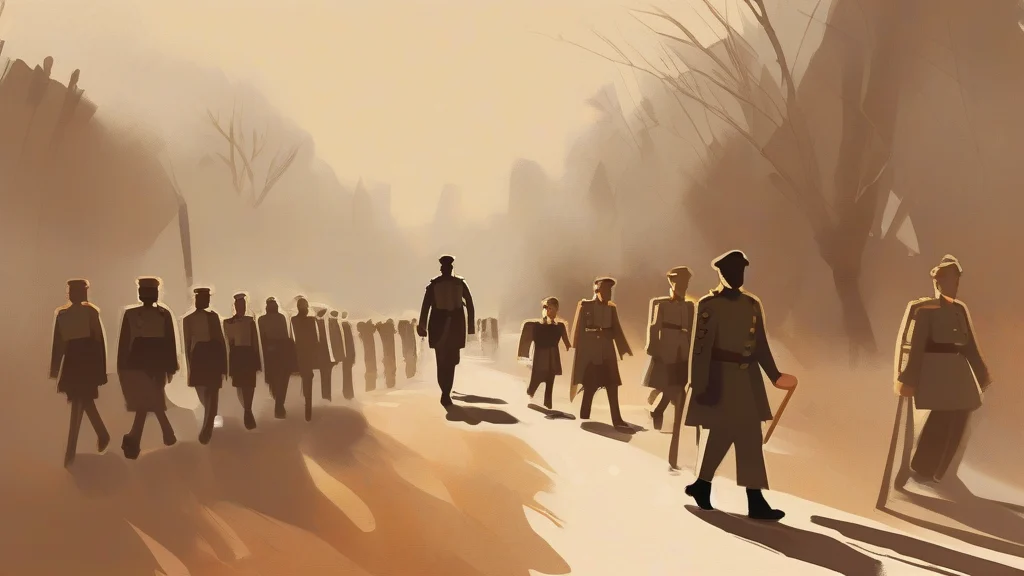
What does march mean?
March describes both a deliberate way of walking and the organized movement of people, troops, or events. As a verb, it means to proceed with firm, regular steps, as soldiers do in formation or demonstrators do along a route. It can also suggest forceful forward movement, especially in phrases such as “march on” or “the march of progress.” As a noun, a march may be a public procession, a military advance, or, in older usage, a frontier or borderland. “March” also names the third month of the year, a name inherited from the Roman calendar and ultimately connected with Mars, the Roman god of war. The word is especially useful because it combines the physical image of steady, purposeful steps with broader ideas of disciplined movement, ceremony, protest, and historical change. In British English, the r in the standard pronunciation is generally not pronounced.
To walk with steady and regular steps, especially as part of a military formation or organized procession; also, to move forward deliberately or forcefully.
"The column marched along the road at a steady pace."
Figurative uses often retain the sense of firm, purposeful forward movement.
An organized procession on foot, a military advance, a boundary or frontier, or the third month of the year.
"The peace march passed several major landmarks before reaching the parliament building."
The sense meaning a frontier is now chiefly historical and is most often encountered in the plural “the Marches,” as in the Welsh Marches.
The plural refers to multiple processions, advances, or historical borderlands. The name of the calendar month remains singular in ordinary date usage.
"Several marches crossed the city on the same afternoon."
March takes its name from Mars, the Roman god of war, while the verb once described the steady tread of soldiers moving into battle.
Reviewed by Deb Chak, Editor. AI-assisted content curated by RJS Tech Solutions LLP.
Where does march come from?
The verb comes through Middle English from Old French marcher, “to march,” ultimately associated with Late Latin marchare, “to march.” The deeper origin of that form is uncertain, though it is often connected with Germanic vocabulary connected with a border or frontier. The month name is different in origin: it comes from Latin Martius, meaning “of Mars,” and was named after the Roman god Mars.
Related word forms
How march is actually used
The verb often suggests steady, purposeful movement and may imply determination or a military context. In the expression “the march of progress,” it refers to steady development. The calendar month is written with a capital letter as “March.”