
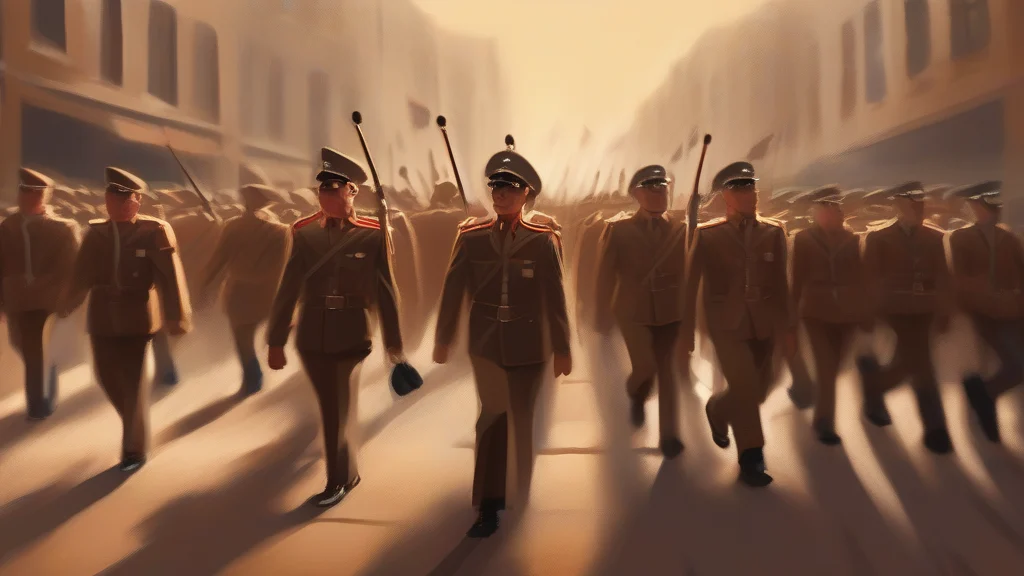
What does marching mean?
Marching means moving forward on foot with regular, deliberate steps, most often in military formation, during a ceremony, or as part of an organized procession. Troops traditionally march in step, while parade movements and ceremonial bands give the word associations with discipline, ceremony, and public display. In broader figurative use, “marching” describes steady or determined progress toward a destination or objective, sometimes suggesting an unstoppable course: “the company is marching toward success.” The present participle also functions attributively, as in “marching band,” “marching orders,” and “marching protesters.” Although the basic sense involves people moving on foot, the expression is readily applied to campaigns, protests, crowds, and abstract movements, making it useful for describing both coordinated action and purposeful momentum.
To walk with steady, regular steps, especially in a military formation or organized procession; figuratively, to proceed toward an objective.
"The column marched through the rain without stopping."
The present participle is commonly used after forms of be: “They were marching toward the river.”
Participating in an organized march, or moving in a steady, coordinated manner.
"The marching band led the procession down the avenue."
This is primarily a participial adjective, as in “marching band,” “marching orders,” and “marching protesters.”
Military marching turns synchronized footsteps into a coordinated unit, allowing a large formation to move with surprising precision.
Reviewed by Deb Chak, Editor. AI-assisted content curated by RJS Tech Solutions LLP.
Where does marching come from?
English march derives from Middle English marches, borrowed from Old French marche, a word associated originally with a frontier or border region. The modern verb meaning “to move with regular steps” developed through the association of walking or processional movement with that older word, while the military sense became especially prominent in the early modern period. The form “marching” is the present participle and gerund of that verb and is also used adjectivally before nouns.
Related word forms
How marching is actually used
The word is common in military, ceremonial, and public-procession contexts. Figurative uses such as “marching toward victory” often convey determined, uninterrupted progress and may have a rhetorical tone.