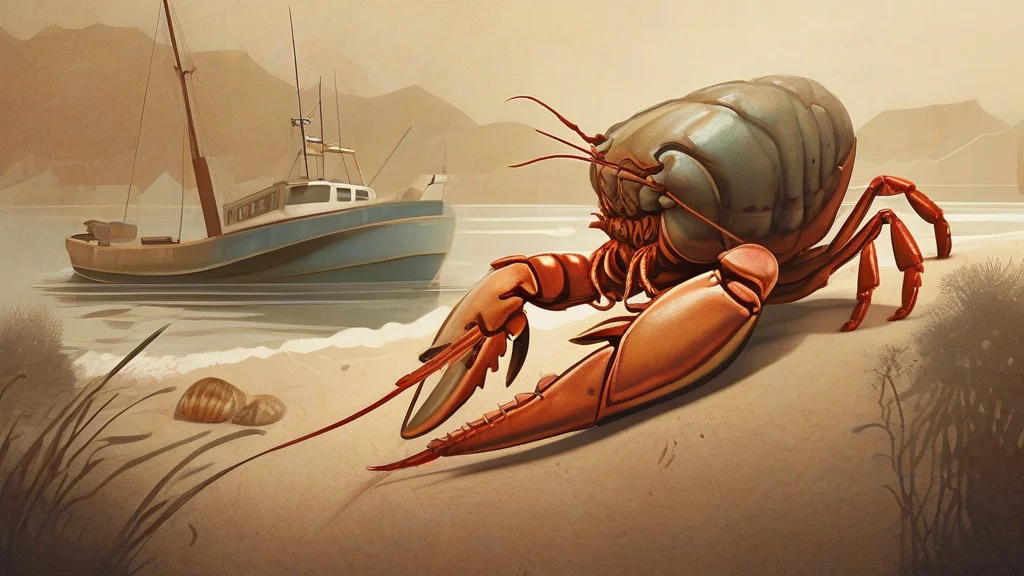
What does crustacea mean?
Crustacea is the scientific name for a large group of aquatic arthropods whose bodies are encased in a hard outer shell. Familiar members include crabs, lobsters, shrimps, prawns, barnacles, and crayfish, along with less obvious ones such as woodlice and water fleas. The name comes from the Latin word for a hard rind or shell, reflecting these animals' most distinctive feature: an external skeleton made largely of chitin and calcium carbonate that must be shed periodically as the animal grows. Most crustacea live in the sea, where they fill roles ranging from filter-feeding plankton to powerful predators, though many species inhabit fresh water and a handful, notably woodlice, live on land. Zoologists use the term chiefly in formal classification and field studies, while everyday speakers usually refer to individual animals as crustaceans. The word carries a precise, technical tone and appears frequently in marine biology, palaeontology, and culinary writing about shellfish.
nounA taxonomic group (traditionally a class) of predominantly aquatic arthropods that includes crabs, lobsters, shrimps, barnacles, and woodlice, characterized by having a hard outer skeleton and typically two pairs of antennae.
- As a collective noun: members of the class Crustacea taken together as a group of animals.
- In formal zoological classification: the taxonomic class Crustacea itself.
"The tide pools were teeming with crustacea — hermit crabs, barnacles, and the occasional small shrimp."
"Barnacles, crabs, and shrimp are among the most familiar crustacea found along rocky shorelines."
"Early naturalists classified woodlice among insects before recognizing them as terrestrial crustacea."
"Crustacea" is already a plural form — the Latin neuter plural of "crustaceus" — so it does not take a further plural ending. It functions collectively to refer to multiple members of the class.
"Freshwater crustacea such as water fleas form a vital part of the aquatic food web."
Every crab, lobster, and pill bug you've ever seen belongs to the Crustacea — a group so successful it has colonized everything from deep-sea vents to your garden soil.
Reviewed by Deb Chak, Editor. AI-assisted content curated by RJS Tech Solutions LLP.
Etymology of crustacea
The word Crustacea comes from Latin, derived from "crusta," meaning a hard outer rind or shell, combined with the suffix "-acea" used for animal groups. It was adopted into scientific nomenclature in the late eighteenth century when French zoologist Pierre André Latreille formally established the group. Related terms include the English "crustacean" (a single member of the group), "crustaceous" (describing something shell-like or crisp in texture), and "crust" itself, all tracing back to the same Latin root.
How crustacea is actually used
Used almost exclusively in scientific, academic, or natural-history contexts rather than everyday speech; in general conversation people more often say "crustaceans" or name specific animals. As a Latin-style plural it takes no separate plural form. In modern classification systems Crustacea is often treated at a higher rank than class, but the word remains standard in both scholarly and popular science writing.
Easily confused with crustacea
"Crustacean" is the singular form referring to one individual animal of this group, while "crustacea" is the plural form used for the group as a whole.