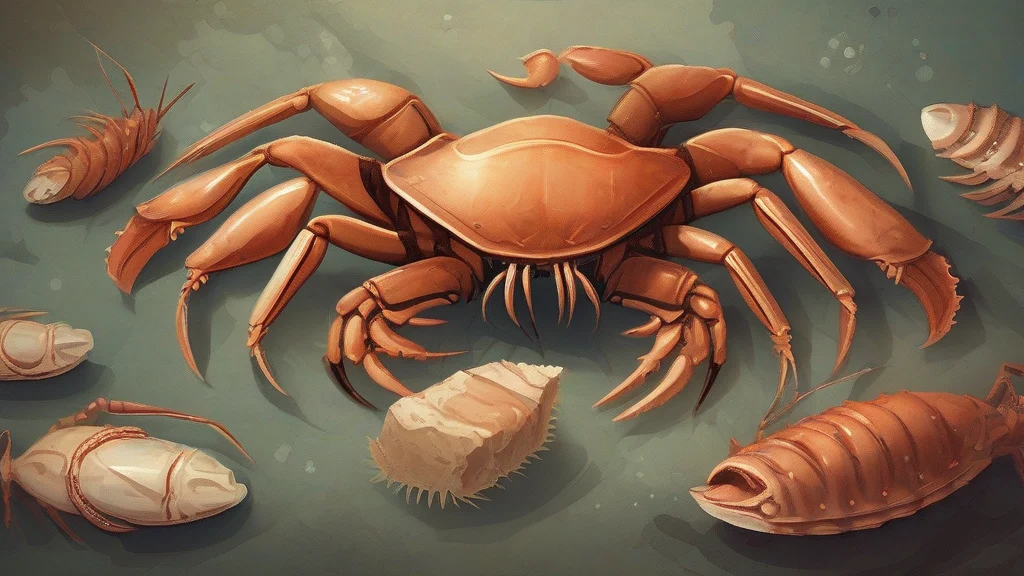
What does crustacean mean?
A crustacean is a type of arthropod belonging to the large and diverse group known scientifically as Crustacea. Most crustaceans live in water, where they breathe through gills, and they share key features: a segmented body, a hard external skeleton that must be shed to allow growth, and paired, jointed limbs. Familiar examples include crabs, lobsters, shrimps, prawns, crayfish, krill, and barnacles, while the garden woodlouse shows that a few species have adapted to life on land. The word appears both in scientific writing, where it carries precise taxonomic meaning, and in everyday contexts such as menus and food labels, where it overlaps with the broader culinary term shellfish. Economically and ecologically, crustaceans matter enormously: many are harvested for food, and tiny krill form the base of ocean food chains. Understanding the term helps distinguish these joint-legged creatures from molluscs like oysters and mussels.
nounA crustacean is an arthropod of the class Crustacea, a large group of mostly aquatic animals with segmented bodies, hard exoskeletons, and paired jointed limbs, including crabs, lobsters, shrimps, crayfish, barnacles, and woodlice.
- Any member of the class Crustacea: a mainly aquatic arthropod with a hard exoskeleton, segmented body, and paired jointed appendages — including crabs, lobsters, shrimps, crayfish, barnacles, krill, and woodlice.
- Loosely or commercially, any edible marine animal of this kind, as discussed in cooking or food contexts.
"The tide pools were teeming with small crustaceans darting between the rocks."
"Lobsters and crabs are among the most familiar crustaceans found along rocky coastlines."
"The restaurant's menu proudly noted that all its seafood was locally sourced, from fin fish to fresh crustaceans."
The plural "crustaceans" is standard when referring to multiple individual animals. When speaking of the taxonomic class collectively, scientists use the Latinized name "Crustacea" instead.
"Rocky shorelines support countless crustaceans, from tiny amphipods to large clawed crabs."
The humble woodlouse scuttling across your garden is technically a crustacean — the only one that has truly conquered dry land.
Reviewed by Deb Chak, Editor. AI-assisted content curated by RJS Tech Solutions LLP.
Etymology of crustacean
The word "crustacean" derives ultimately from Latin "crusta", meaning a hard outer surface or rind, such as the crust of bread. It entered English in the early nineteenth century, formed on the New Latin "Crustacea", the name Linnaeus-era naturalists gave to this class of hard-shelled aquatic animals. It thus belongs to a family of English words built on "crusta", including "crust", "crusty", "crustaceous", and "encrust", all evoking something covered by or having a hardened outer layer.
Related word forms
How crustacean is actually used
"Crustacean" is a neutral, standard scientific and everyday term; it is common both in biology texts and in culinary writing. The plural "crustaceans" is normal when referring to individuals; "Crustacea" refers to the taxonomic class as a whole. In strict zoological usage, not all animals popularly called shellfish are crustaceans — oysters and mussels are molluscs, not crustaceans.
Easily confused with crustacean
Molluscs are soft-bodied invertebrates often protected by shells, such as clams and snails, whereas crustaceans are arthropods with jointed legs and segmented exoskeletons, such as crabs and shrimp.
Shellfish is a broad culinary category covering both crustaceans and molluscs, so it is not interchangeable with the more precise biological term crustacean.