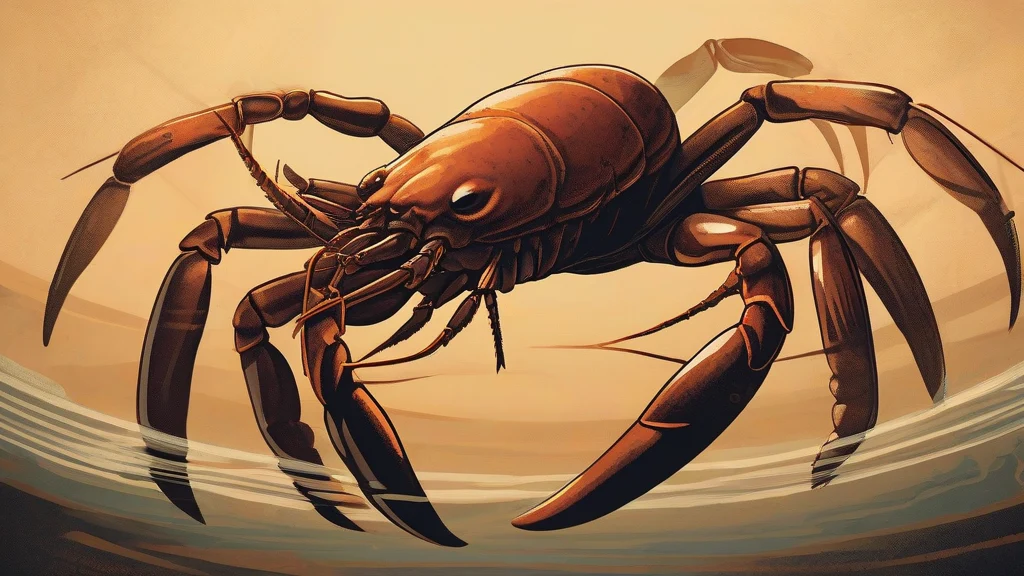
What does decapod mean?
A decapod is any member of Decapoda, the large and familiar order of crustaceans whose name comes from the Greek for 'ten-footed', referring to their five pairs of thoracic legs. The group includes many of the best-known shellfish — crabs, lobsters, shrimps, prawns, crayfish, and krill-like species — making it one of the most economically and ecologically significant orders in the sea. In everyday language the word is uncommon; people usually say 'crab' or 'lobster' rather than 'decapod'. Instead, it appears mainly in marine biology, palaeontology, fisheries science, and nature writing, where a single collective term is genuinely useful. Adjectival forms such as 'decapod' or 'decapodan' describe features of these animals, as in 'decapod larvae'. For readers of popular science, knowing the word unlocks a whole branch of zoology: whenever an article groups crabs with shrimps under one label, that label is decapod.
nounA crustacean of the order Decapoda, having ten limbs, including shrimps, lobsters, crabs, and prawns. More broadly, any member of the order Decapoda.
- A ten-limbed crustacean of the order Decapoda, such as a crab, lobster, shrimp, or prawn.
- In older or broader zoological use: any animal having ten feet or leg-like appendages.
"The rock pool was alive with small decapods scuttling among the weeds."
"Biologists catalogued dozens of decapods during the reef survey."
"The fossil record shows decapods diversifying rapidly after the end-Cretaceous period."
Standard English plural; the Latinized form 'decapoda' is not used as a plural in English prose except within taxonomy, where Decapoda is capitalized as the order name.
"Many decapods can regenerate lost limbs over successive moults."
Lobsters, crabs, and shrimps all share one defining trait: exactly ten legs — which is literally what their scientific order name, Decapoda, means in Greek.
Reviewed by Deb Chak, Editor. AI-assisted content curated by RJS Tech Solutions LLP.
Etymology of decapod
The word decapod derives from the Greek 'dekapous' (deka- meaning 'ten' + pous meaning 'foot'), via the modern Latin scientific name Decapoda coined for the crustacean order. It entered English in the early 19th century as naturalists formalized crustacean classification. It shares its numerical root deka- with words like 'decade' and 'decimal', and its -pod element with other zoological terms such as 'arthropod', 'cephalopod', and 'tripod'.
Related word forms
How decapod is actually used
Primarily a technical term used in marine biology, zoology, and fisheries science; rare in everyday conversation, where speakers simply name the specific animal (crab, lobster, shrimp). The capitalized form Decapoda refers to the taxonomic order.
Easily confused with decapod
A cephalopod is a soft-bodied mollusc such as an octopus or squid, whereas a decapod is a ten-limbed crustacean such as a crab or lobster.