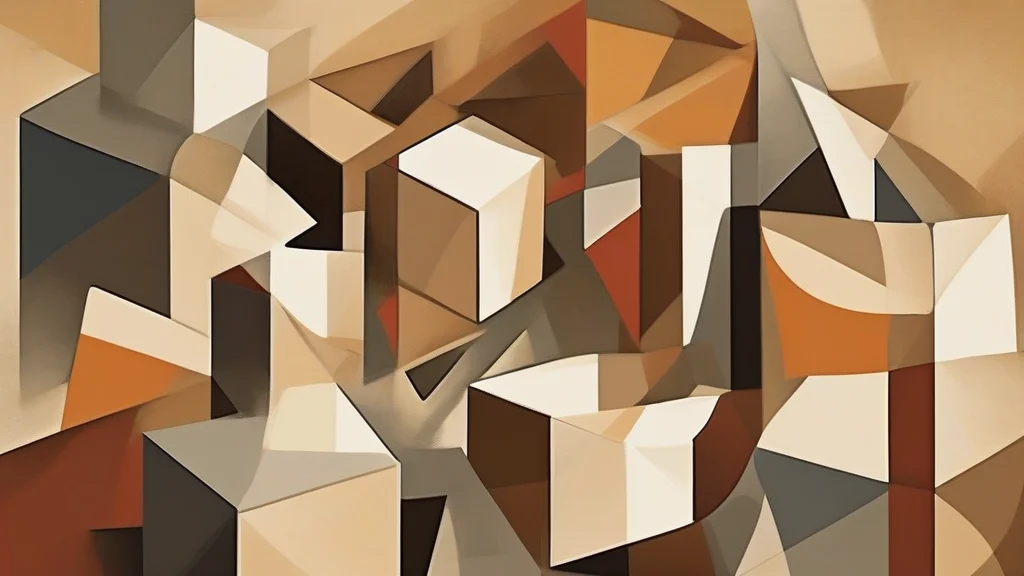
What does cubism mean?
Cubism is an influential avant-garde art movement that emerged in Paris in the early twentieth century, pioneered by Pablo Picasso and Georges Braque. Rejecting the Renaissance tradition of representing objects from a single, fixed viewpoint, cubist artists broke their subjects into fragmented planes and geometric forms, often showing several angles of an object at once on a flat canvas. The movement developed through two main phases — Analytic Cubism, with its muted colors and dense faceting, and Synthetic Cubism, which introduced collage and brighter palettes. Though centered on painting, cubism profoundly influenced sculpture, architecture, design, and literature, making it one of the most consequential artistic revolutions of the modern era. The term originated from a critic's remark that Braque reduced landscapes to little cubes, and it remains essential vocabulary for anyone discussing modern art.
nounAn early 20th-century avant-garde art movement, pioneered by Pablo Picasso and Georges Braque, in which objects are depicted as fragmented, geometric forms shown from multiple viewpoints simultaneously.
- An early 20th-century style of art in which subjects are broken into geometric shapes and depicted from multiple perspectives at once.
"The gallery's new exhibition traces the evolution of cubism from its analytic phase to its later synthetic period."
"Les Demoiselles d'Avignon is often cited as the starting point of cubism."
"Her lecture explained how cubism abandoned the single fixed viewpoint that had dominated Western painting since the Renaissance."
Extremely rare; occasionally used in scholarly writing to refer to distinct varieties or manifestations of the movement (e.g., French versus Czech cubism), but standard usage treats the word as uncountable.
"Scholars have distinguished several national cubisms across Europe during the 1910s."
When Picasso and Braque invented cubism around 1907–1908, one critic joked that Braque had reduced everything to 'little cubes' — and a revolutionary movement got its name from mockery.
Reviewed by Deb Chak, Editor. AI-assisted content curated by RJS Tech Solutions LLP.
Etymology of cubism
The word derives from French 'cubisme', which emerged around 1908–1909 after the critic Louis Vauxcelles remarked that Georges Braque's paintings reduced everything to geometric outlines and 'little cubes'. It ultimately traces back to Latin 'cubus' and Greek 'kybos', meaning a cube or die. Related English forms include 'cube' and 'cubical'. The term was initially used mockingly by critics before being adopted by the artists themselves.
Related word forms
How cubism is actually used
Usually capitalized as 'Cubism' when referring to the historical art movement, though lowercase 'cubism' is also accepted; always written as a singular mass noun. Often used with the adjectives 'Analytic' and 'Synthetic' to distinguish its two principal phases (roughly 1909–1912 and 1912 onward).
Easily confused with cubism
Cubist refers to an artist or work belonging to the movement, while cubism is the movement itself.