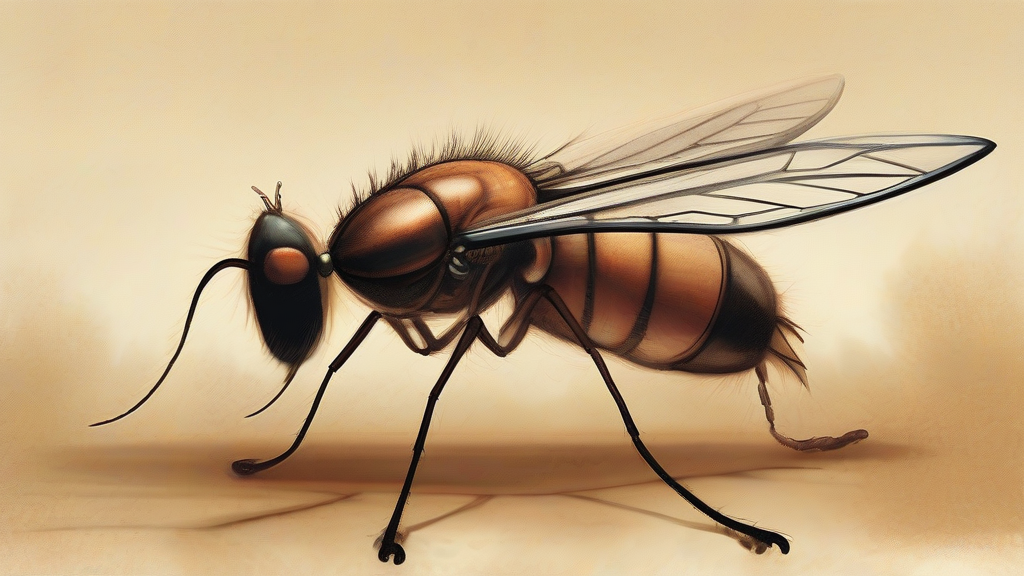
What does diptera mean?
Diptera is the biological order that encompasses all true flies — including houseflies, blowflies, mosquitoes, gnats, and midges. The name comes from Greek roots meaning 'two wings', reflecting the group's defining trait: adult Diptera possess just a single pair of functional flight wings, their hind wings having evolved into halteres, small knobbed organs that act like gyroscopic stabilizers during flight. With well over 150,000 described species, Diptera is one of the largest and most ecologically important insect orders, playing vital roles as pollinators, decomposers, and prey for other animals — while also including medically significant vectors such as the mosquito, which transmits malaria and other diseases. The term appears almost exclusively in scientific, educational, and technical writing; lay speakers simply say 'flies' or 'flies and mosquitoes'. Grammatically it functions as a plural noun, so one writes 'the Diptera are abundant', and its adjectival forms are 'dipteran' and 'dipterous'.
nounA large order of insects comprising the true flies, characterized by having a single pair of membranous wings; the hind wings are reduced to club-shaped balancing organs called halteres.
- The taxonomic order of insects that includes all true flies, mosquitoes, gnats, and midges, distinguished by possessing only one pair of functional wings.
"Mosquitoes and houseflies both belong to the order Diptera."
"The entomologist spent her career cataloguing the Diptera collected from tropical rainforest canopies."
"Because many disease-carrying insects fall within Diptera, public-health researchers study the order intensively."
Diptera is already plural in form and usage, following Latin convention for order names; it has no distinct plural. An individual member of the order is called a dipteran.
"The Diptera are among the most diverse insect orders on Earth."
Every 'fly' you've ever swatted belongs to one group: the name Diptera literally means 'two wings' in Greek, because flies gave up their back pair and turned them into tiny gyroscopes called halteres.
Reviewed by Deb Chak, Editor. AI-assisted content curated by RJS Tech Solutions LLP.
Etymology of diptera
Diptera derives from New Latin, adopted as a formal taxonomic name in the era of Linnaean classification, ultimately from Greek 'di-' meaning 'two' and 'pteron' meaning 'wing'. The same Greek root 'pteron' recurs across zoological nomenclature in names such as Lepidoptera (scaled wings — butterflies and moths) and Coleoptera (sheathed wings — beetles), and it also survives in everyday English in 'helicopter' and 'pterosaur'. Related English derivatives of the headword itself include the adjective 'dipterous' and the noun 'dipteran', used for an individual fly belonging to the order.
Related word forms
How diptera is actually used
Diptera is a formal scientific term used chiefly in entomology and biology. In everyday speech people simply say 'flies'. As a taxonomic name it is always capitalized when referring to the formal order, though lowercase use is common in general prose. It is treated grammatically as a plural noun ('the Diptera are'), matching Latin practice.
Easily confused with diptera
Diptera is the insect order of two-winged flies such as houseflies and mosquitoes, while Lepidoptera is the order of butterflies and moths with scaled four-winged adults.
A diploma is a certificate awarded for completing a course of study, whereas Diptera is a scientific order of flies; the confusion arises mainly from similar opening letters.