What does dipterous mean?
Dipterous is a scientific adjective describing insects that have exactly two functional wings. It applies chiefly to members of the order Diptera — the true flies — which includes houseflies, mosquitoes, gnats, midges, and hoverflies. In these insects the rear pair of wings found in most flying insects has evolved into halteres, small club-shaped organs used for balance during flight, making the single wing pair their defining feature. The word is used almost entirely within entomology, appearing in phrases such as 'dipterous larvae' when researchers describe the maggots and grubs produced by two-winged insects. Because it derives from Greek roots meaning 'two-winged', it carries a precise technical connotation rather than any emotional colouring, and it has no figurative use in ordinary English. Readers encountering it outside scientific contexts will usually find it in nature writing or popular science, where it lends precision and authority to descriptions of flies and their remarkable evolutionary adaptations.
adjectiveHaving two wings; belonging or relating to the Diptera, the order of insects comprising flies, mosquitoes, and gnats.
- Of an insect: having only two functional wings, characteristic of the order Diptera (flies).
- Belonging to or characteristic of the order Diptera.
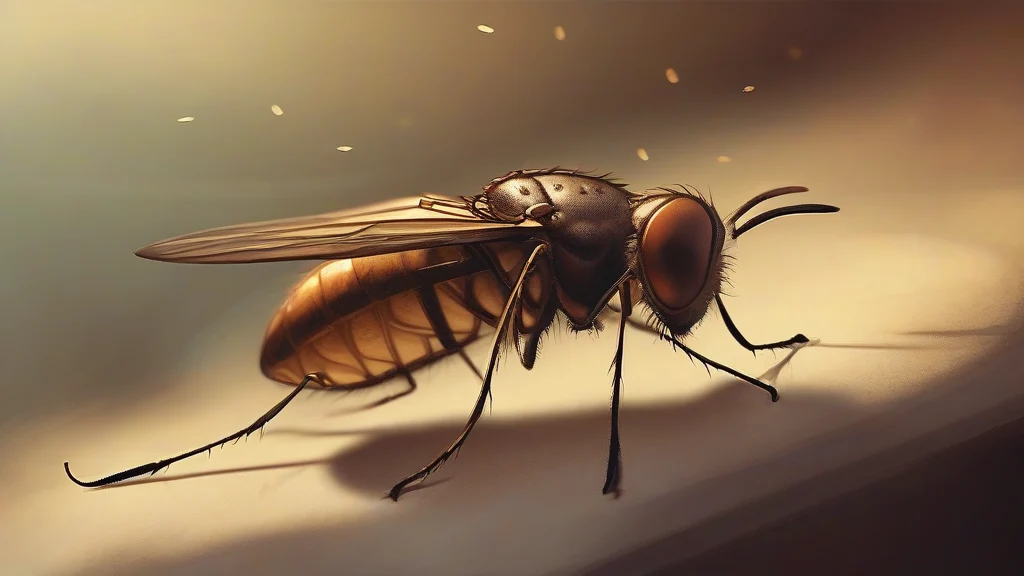
"The dipterous insect rested on the windowsill, its two translucent wings folded neatly over its back."
"Dipterous adults possess a single pair of membranous wings, the hind pair having been reduced to tiny balancing organs called halteres."
"Many dipterous species are important pollinators, despite the family's reputation for pestilence."
Every 'fly' you've ever met — housefly, mosquito, gnat — is dipterous: just one pair of wings, where most insects have two pairs.
Reviewed by Deb Chak, Editor. AI-assisted content curated by RJS Tech Solutions LLP.
Etymology of dipterous
The word dipterous comes from New Latin 'Diptera', the name of the fly order, which itself derives from the Ancient Greek 'dipteros' meaning 'two-winged' — a compound of 'di-' (twice) and 'pteron' (wing). The same Greek root 'pteron' appears in other scientific terms such as 'helicopter' and 'lepidoptera'. The adjective entered English scientific vocabulary in the nineteenth century alongside the rise of modern entomological classification.
How dipterous is actually used
A technical term used almost exclusively in entomology and formal scientific writing; it would sound stilted in everyday conversation. The adjectival form parallels the noun 'dipteran', which refers to an individual fly as a noun.
Easily confused with dipterous
A diplomat is an official representing a country abroad, while dipterous describes two-winged insects of the order Diptera.