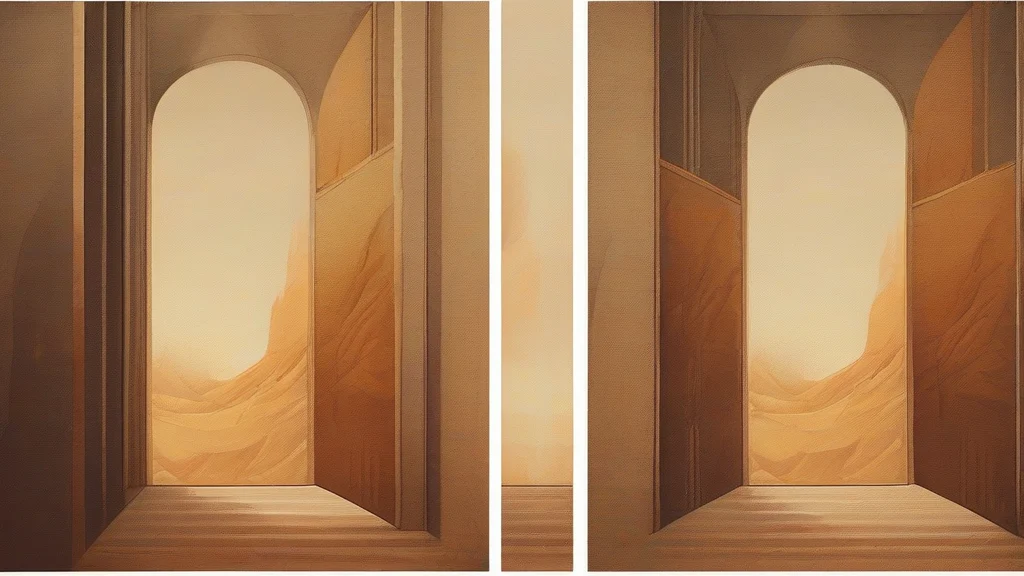
What does diptych mean?
A diptych is a work made up of two panels joined together, most often by hinges, so that they can stand open like a book or fold closed for protection. In art history the term usually refers to a two-panel altarpiece or devotional image, frequently painted on wood and sometimes on both sides of each panel. By extension, writers, filmmakers, and critics use diptych figuratively to describe any pairing of two complementary works, narratives, or images intended to be viewed as a single unified composition. The word carries a scholarly, refined connotation and appears chiefly in museum catalogues, criticism, and academic writing rather than casual conversation. Its close cousins include the triptych, with three panels, and the polyptych, with many.
nounA diptych is a work of art consisting of two painted or carved panels that are hinged together, or more broadly any paired set of two corresponding pictures, texts, or objects presented side by side.
- A two-panel artwork, typically hinged, especially an altarpiece or portable devotional painting.
- By extension, any pair of related pictures, texts, or events presented as a matched whole (e.g. in literature or film).
"The museum acquired a fifteenth-century diptych whose hinged panels could be closed for travel."
"The altarpiece is a small diptych that folds shut to protect its painted inner surfaces."
"Her novel works as a diptych, alternating between a mother's and a daughter's account of the same summer."
Standard English plural, adding -s; no alternative form is widely accepted.
"Several late-medieval diptychs survive with portraits of their original donors."
Roman consuls once handed out ivory diptychs as luxury souvenirs — the ancient equivalent of a commemorative plaque.
Reviewed by Deb Chak, Editor. AI-assisted content curated by RJS Tech Solutions LLP.
Etymology of diptych
Diptych comes from the Greek 'diptychos', meaning 'twofold' or 'double-folded', formed from 'di-' (two) and 'ptyche' (fold). It entered English in the early seventeenth century, initially referring to ancient writing tablets made of two leaves hinged together, coated with wax. The term later extended to the paired devotional and altarpiece paintings of medieval and Renaissance Europe, and cognates such as triptych and polyptych share the same Greek root.
How diptych is actually used
Formal register, common in art history, museology, and literary criticism; rare in everyday speech.
Easily confused with diptych
A triptych has three panels, whereas a diptych has exactly two.