What does fauve mean?
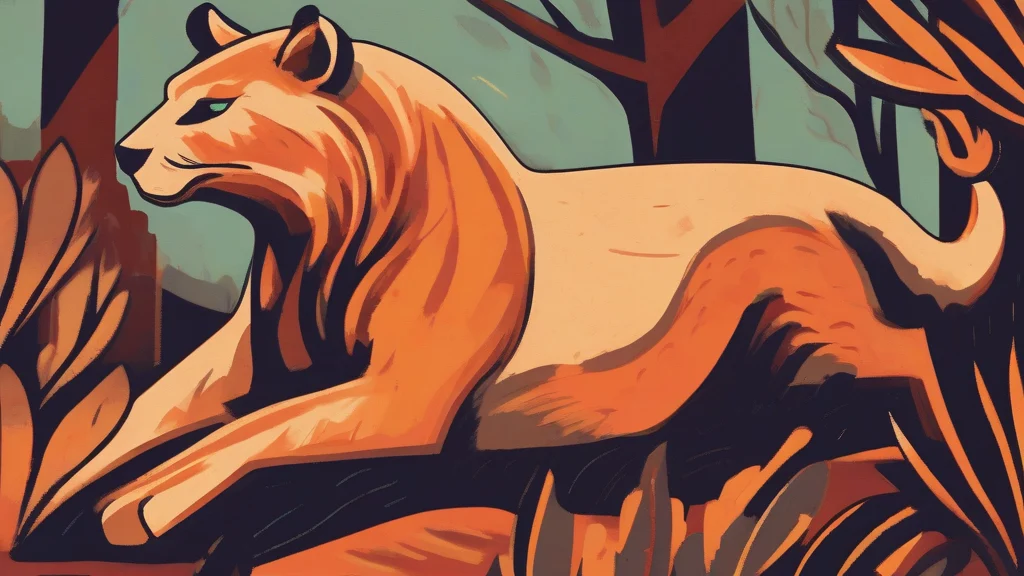
Fauve entered English from French, where it denotes a wild beast and, by extension, a tawny, fawn-like brown reminiscent of the coats of lions and other predators. Its most visible modern life, however, comes from art history: when Parisian critics saw the violently coloured canvases of Matisse, Derain, Vlaminck, and their circle at the 1905 Salon d'Automne, they mockingly dubbed them 'les fauves' — the wild beasts. The painters embraced the label, and Fauvism became a landmark movement celebrated for liberating colour from description. In English today, calling someone a fauve nearly always means they painted in that style or share its chromatic boldness; the literal zoological sense and the colour sense are now rare outside French. Knowing 'fauve' therefore connects vocabulary, colour terminology, and one of the great origin stories of modern art.
nounA fauve is a wild beast or savage animal, or, in modern art historical use, a painter belonging to Fauvism, the early twentieth-century French movement known for bold, non-naturalistic colour. The word also denotes a dull fawn or tawny brown colour.
- A wild, savage animal; a beast of prey.
- A painter of the Fauvist movement in early twentieth-century France.
- The tawny, fawn-brown colour associated with such animals.
"The critics derided Matisse and his fellow fauves for their riotous, arbitrary colours."
"The gallery's new exhibition traces how the fauves shattered centuries of academic colour convention."
"Her scarf was a soft fauve that recalled a lion's coat in winter."
Standard plural; used especially when referring collectively to the Fauvist painters.
"The fauves exhibited together only briefly before their paths diverged."
"Wild beasts" was the insult that named an art movement — and the painters wore it proudly.
Reviewed by Deb Chak, Editor. AI-assisted content curated by RJS Tech Solutions LLP.
Etymology of fauve
French 'fauve' descends from medieval Latin forms of uncertain Germanic origin (often traced to a Latinized *falvus meaning yellowish), blended with the influence of Latin ferus, 'wild', which supplied its bestial meaning. From the animal sense came the tawny colour associated with such creatures. When French journalists applied the word to Matisse's circle around 1905, the term crossed into English as both an art-historical label and the root of 'Fauvism'.
Related word forms
How fauve is actually used
In contemporary English, 'fauve' is encountered almost exclusively in art-historical writing, where it usually names a Fauvist painter; its older zoological and colour meanings survive mainly in dictionaries and in borrowings from French. In French, 'fauve' remains a common adjective and noun covering both wild animals and tawny colours.
Easily confused with fauve
Fallow is a separate pale yellowish-brown colour (and a term for ploughed fields), whereas fauve refers either to a wild beast or to a deeper tawny, fawn-like hue.